
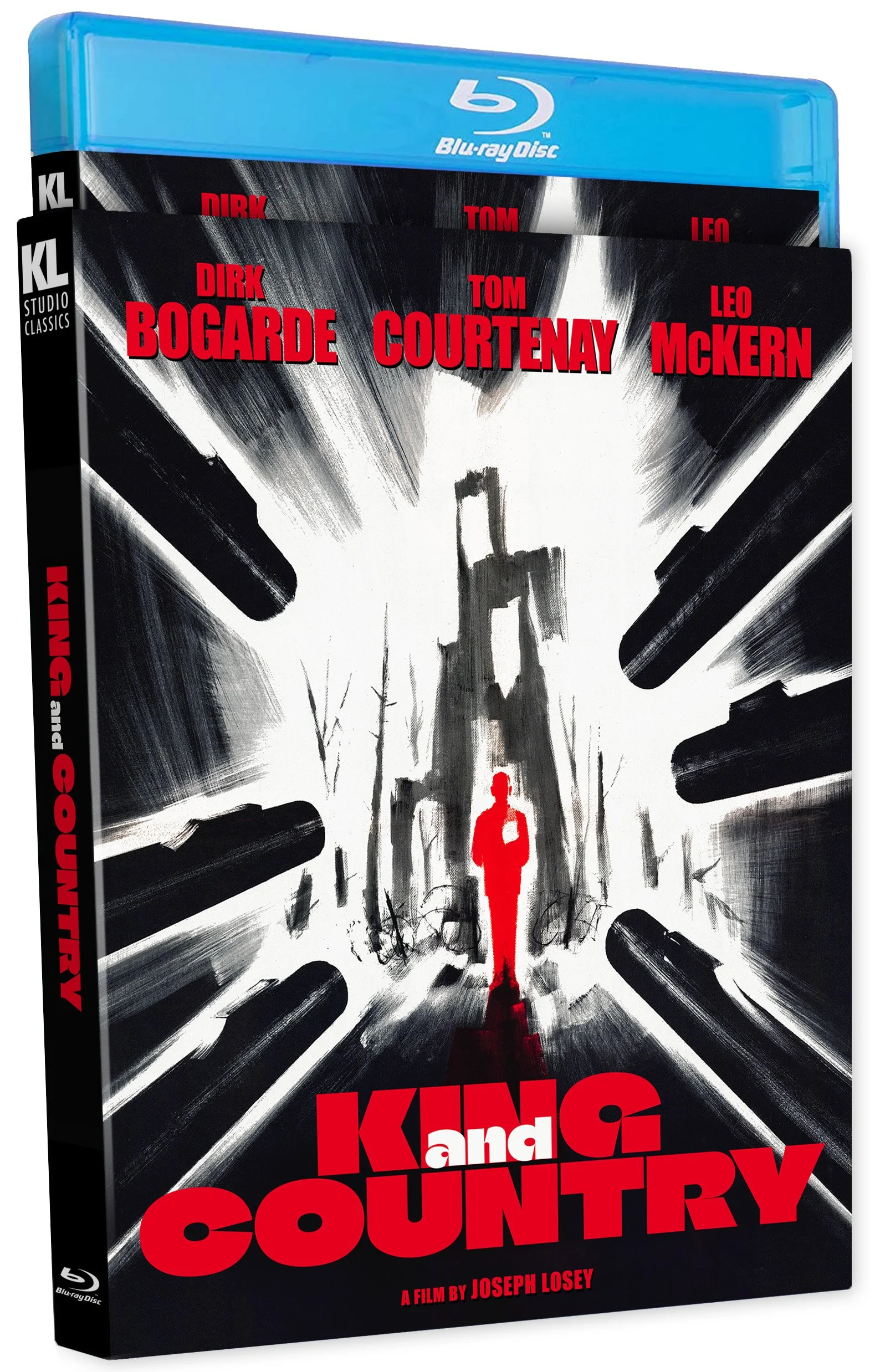
King and Country (Web Exclusive)
Reviewed by David Sterritt
Produced by Joseph Losey and Norman Priggen; directed by Joseph Losey; screenplay by Evan Jones, from the stage play by John Wilson, based on a story by James Lansdale Hodson; cinematography by Denys Coop; edited by Reginald Mills; production design by Richard Macdonald; art direction by Peter Mullins; music by Larry Adler; starring Dirk Bogarde, Tom Courtenay, Leo McKern, Barry Foster, Peter Copley, James Villiers, Jeremy Spencer, Barry Justice, Vivian Matalon. Keith Buckley, James Hunter, Jonah Seymour, Larry Taylor, David Cook, Richard Arthure, Raymond Brody, Dan Cornwall, and Terry Palmer. Blu-ray, B&W, 86 min., 1964. A Kino Lorber Studio Classics release.
Joseph Losey’s 1964 King and Country straddles two broad subgenres of antiwar cinema: the many films depicting the brutal violence of combat, ranging from King Vidor’s classic The Big Parade (1925) to Edward Berger’s version of All Quiet on the Western Front (2022), and the many films taking indirect routes, such as Robert Wise’s science-fiction parable The Day the Earth Stood Still (1951) and Dalton Trumbo’s radically unsparing Johnny Got His Gun (1971). Fighting is always near in King and Country, which takes place in a British encampment during the third horrific year of World War I, but the combat is never explicitly shown. Instead, the film focuses on a legal proceeding against a hapless private charged with deserting his regiment. Like the wartime fable The Boy with Green Hair (1948), which had launched Losey’s career a decade and a half earlier, King and Country is very much concerned with questions of dignity, individuality, and personhood. But here the allegorical nature of the earlier film is replaced by excruciating evocations of war’s horrific effects, embodied by the squalor of the setting, bogged in filthy mud and pummeled by drenching rain, and by the looming injustice of a court martial that wends its hasty way toward a conclusion as inevitable as it is grim. Losey films of the Sixties can be moody (1963’s The Servant) or flashy (1966’s Modesty Blaise) or melodramatic (1968’s Secret Ceremony) or baroque (1968’s Boom!), but this one is somber, single-minded, and relentless. It exemplifies his boldness as a visual stylist and reaffirms the political seriousness that had driven him out of the United States in the early Fifties as a victim of the Red Scare and the Hollywood Blacklist.
Private Hamp (Tom Courtenay), accused of desertion, and Captain Hargreaves (Dirk Bogarde), his defense counsel, prepare for the court-martial.
The source of Evan Jones’s screenplay is Hamp, a 1964 play by John Wilson based on an incident from a 1955 novel by James Lansdale Hodson, a war correspondent and occasional screenwriter. Played by Tom Courtenay in the film, Hamp is as ordinary as an ordinary man can get. He enlisted in the military for no particular reason, fought for a while as well as he could manage, got wounded, saw everyone else in his unit die, and one day just started walking away from the line of battle, with no destination in mind and no purpose except to get some respite from all the noise and chaos. He was arrested after a day or so and charged with desertion, but he can’t believe the army would dole out much censure for such a simple and sensible act; in his view, he’s not important enough to deserve severe punishment, and that attitude of ingenuous denial says a lot about his self-respect and his intelligence, neither of which amounts to much. His court-martial is imminent, and the first part of the film shows his defense attorney, Captain Hargreaves (Dirk Bogarde), questioning him about his background and counseling him on what he should and shouldn’t say during the trial. This isn’t easy, since Hamp is really dim; the best advice Hargreaves can offer him is to come across as a mild and decent guy, and maybe the fact that his wife recently took up with another man could add a vulnerability factor.
The tribunal then begins. None of the witnesses who speak are very helpful to the defendant, and some are as useless as Captain O’Sullivan (Leo McKern), the company physician, who has no patience with excuses like “shell shock” and thinks pretty much anything can be cured with a laxative pill and a “good cleanout.” Hargreaves centers his defense on establishing Hamp’s individuality, his fundamental value as a unique human being caught up by forces beyond his control. But claims of individuality and uniqueness are ill suited to the impersonal views of the officers in charge, who see the execution of a deserter as a morale booster for everyone else. (Carl Foreman’s 1963 film The Victors uses the execution of a World War II deserter as a similar emblem of mercilessness in the name of patriotism.) The outcome of the proceeding is unsurprisingly negative. The letter of the law makes no allowance for Hamp’s dereliction, and as the unsympathetic Captain Midgley (James Villiers) observes, “A proper court is concerned with law. It’s a bit amateur to plead for justice.”
Captain Hargreaves (Dirk Bogarde) prepares his defense of Private Hamp (Tom Courtenay) in another officer’s tent.
Hamp is condemned to die the morning after the trial, and the film then takes a few unexpected turns. With a long and dreary night ahead of them, Hamp’s mates regale him with a wild party, staving off the dread of impending death by getting him and themselves blotto on liquor they have stashed away. In other well-meaning gestures, the chaplain (Vivian Matalon) offers the comfort of prayer and a comradely lieutenant (Barry Foster) offers the better comfort of a soporific drug injection. When the firing squad finally performs its dismal task, at least one shooter misses the target—led by misplaced compassion, perhaps, or maybe just bleariness from all the booze—leaving Hamp mortally hurt but still conscious and aware. Hargreaves finishes the job with a coup de grace from his pistol, but not before Hamp, ever dutiful in his own sad way, apologizes to him for not being dead yet. This finale can be criticized for overstating the film’s case against dehumanization, obduracy, and military mindsets, but it makes for powerful drama and scathing politics.
The film’s take on Great War legality seems plausible. In the audio commentary for Kino Lorber’s new Blu-ray edition, critic Simon Abrams serves up numerous statistics, averring that British authorities pursued some 25,000 courts-martial against soldiers accused of being absent without leave, 20,000 against men charged with disobedience or insubordination, and 4,000 against those who allegedly caused self-inflicted wounds, which Hamp admits he once considered doing. Abrams uses these figures to argue that British culture had no recent experience of wartime exigencies and was somewhat adrift when the conflict broke out; in a video extra on the disc, Bogarde says that prior to World War I no war in a century had made Brits feel fully engaged. Hamp is too naive to have sophisticated notions of patriotism or the greater good, and like countless others he’s utterly unprepared for what awaits him and ill-equipped to cope when reality comes crashing down. Asked by Hargreaves why he enlisted, his first answer is “king and country,” a rote cliché that pops out almost by itself; a bit more prodding reveals that he signed up because someone dared him and he didn’t have anything better to do—in short, he had no idea what he was in for. Abrams quotes Losey’s remark that “hypocrisy” was the major theme of his career, but Hamp’s automatic “king and country” is too unthinking to merit even that opprobrious label. It’s a platitude, not a thought, and its profound irony makes it a far better title than the generic Hamp of the original play.
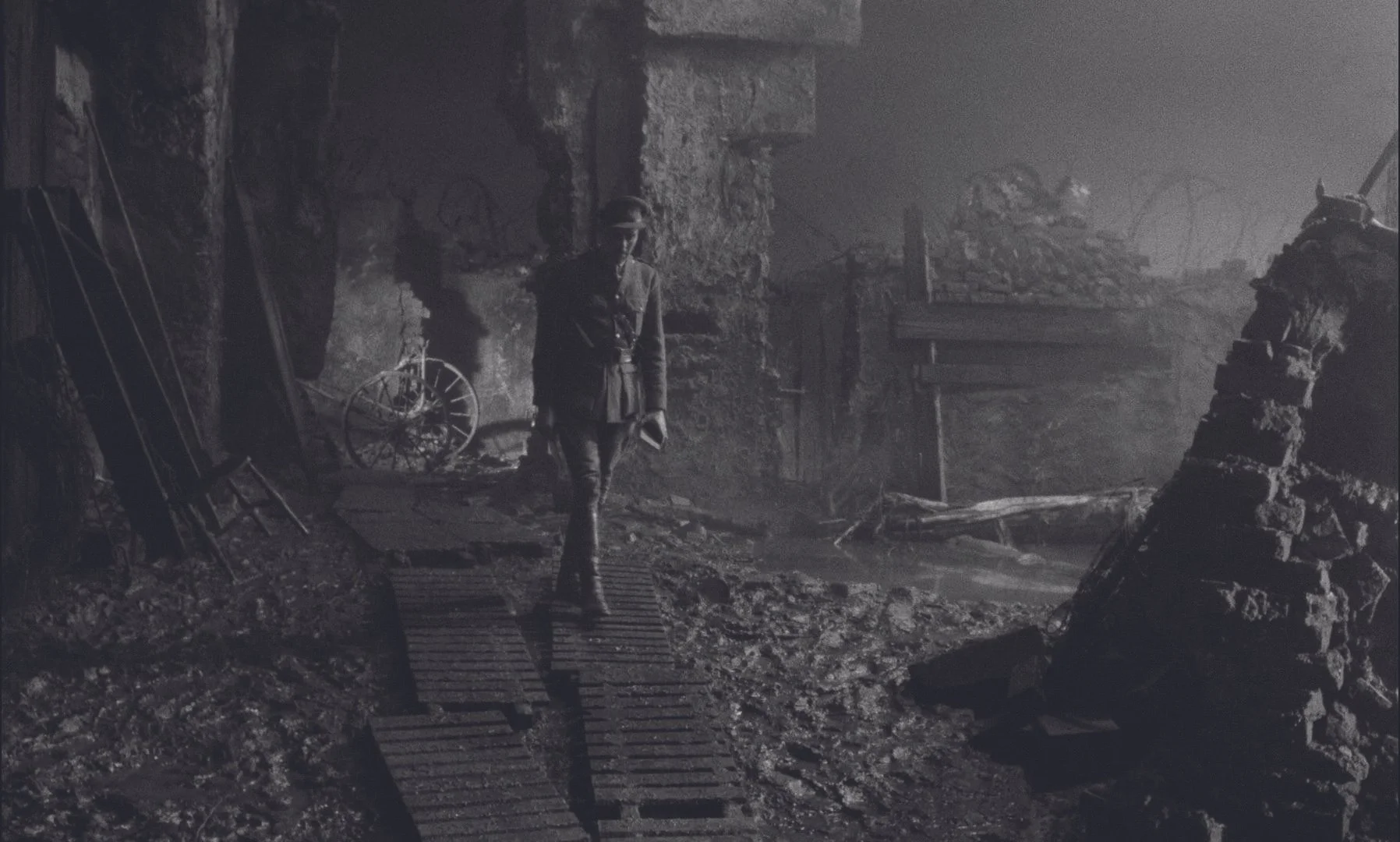
Bleak surroundings echo the bleak prospects for the trial over which defense counsel Hargreaves (Dirk Bogarde) is brooding.
Reaching beyond its legal and military levels, King and Country is also a forceful indictment of capital punishment, and here Wilson’s introduction to the published play is worth quoting: “This story is about a group of men who, required to implement a law they believe to be in principle necessary and just, experience its working in practice as horrifyingly wrong.…[T]hey find that the death of their own deserter…even while they are preparing for it in the ceremony of a court-martial, is unimaginable to them. When it does happen, they know they are taking part in an act of ritual murder. They know that in terms of their law Hamp has been justly proved guilty beyond any doubt; but for the rest of their lives they will not be able to forget his innocence.” Losey, an old-line leftist in the finest tradition, surely agreed.
He also agreed with the artistic theories of his fellow leftist Bertolt Brecht, who advocated the use of distancing methods that encourage audiences not only to be moved and absorbed by a story but to also think about it actively and critically while it’s unfolding. Losey skillfully deploys this technique in King and Country, giving the film great emotional power while opening brief spaces for viewers to reflect and come to their own conclusions about what they’re seeing and hearing. The narrative frequently cuts away from the main action to show a sort of Greek chorus of ordinary soldiers laboring in the ever-present mud, making sardonic comments on their situation, and holding a mock trial of a stray rat that mimics the very real trial going on a few yards away. (In the film’s most repellent image, they pound on a dead horse’s slit-open carcass and rats come pouring out. Losey felt the horse was “very beautiful,” according to Abrams’s commentary.) The chorus isn’t present in Wilson’s play, and Losey felt it didn’t work as effectively as he had hoped, but it functions well as a Brechtian device, as do other quick interludes—brief images from bygone memories, spasms of stomach pain causing Hamp to interrupt the trial and race to the latrine—that punctuate the plot from time to time. Losey is no Jean-Marie Straub or Jean-Luc Godard, and he certainly doesn’t go for the nonnaturalistic acting that Brecht favored, but his political agenda is woven through the style as well as the story of King and Country.
A fellow soldier offers consolation as Private Hamp (Tom Courtenay) awaits trial for deserting his unit under fire.
The new Kino Lorber Studio Classics edition includes video interviews with Courtenay, who won the Best Actor award at the Venice Film Festival and says the production was “easy to shoot” despite the physical hardships, and Bogarde, who recalls the actors being as constantly soaked and muddy as the characters they were playing. He also applauds the film’s accuracy, speaking as someone who studied World War I history from childhood and made uncredited contributions to the script. Abrams’s breathlessly delivered commentary track offers few ideas of its own, instead piling up quotations from other critics (Michel Ciment, Colin Gardner, Andrew Sarris, Pauline Kael, Tom Milne, etc., etc.) who have written on the film over the years. While it’s a reasonably good extras package, nobody quotes the words I associate most strongly with this movie, penned by the brilliant trench poet Wilfred Owen in 1918: “My subject is War and the pity of War. The Poetry is in the pity.” Mournful poetry and heartfelt pity are the greatest attributes of King and Country, which demands renewed attention in our own time, when the stench of war is again imperiling an unstable world.
David Sterritt is author or editor of seventeen books on film.
Copyright © 2026 by Cineaste, Inc.
Cineaste, Vol. LI, No. 2
Quisque iaculis facilisis lacinia. Mauris euismod pellentesque tellus sit amet mollis.