
One Battle After Another (Preview)
Reviewed by Robert Koehler
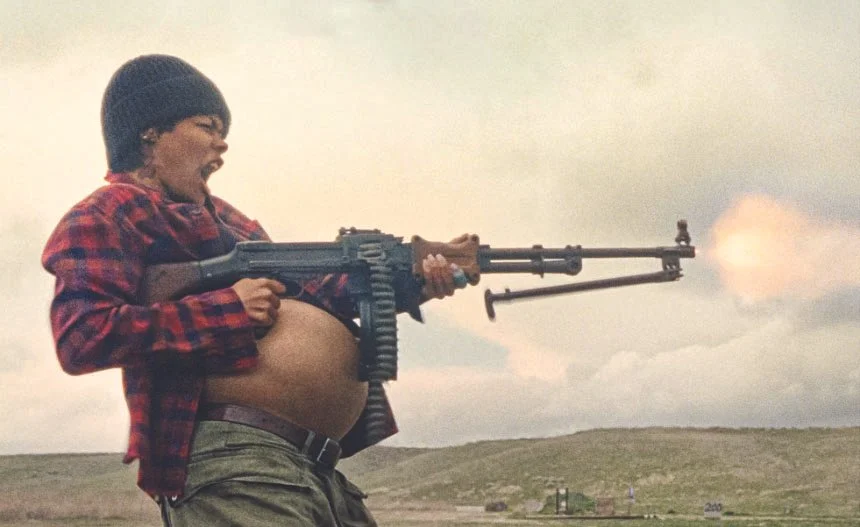
Perfidia Beverly Hills (Teyana Taylor) continues the revolutionary struggle, at least in practice, even while pregnant.
Produced by Paul Thomas Anderson, Sara Murphy, and Adam Somner; directed by Paul Thomas Anderson; screenplay by Paul Thomas Anderson, inspired by the novel Vineland by Thomas Pynchon; cinematography by Michael Bauman; edited by Andy Jurgensen; production design by Florencia Martin; costume design by Colleen Atwood; edited by Andy Jurgensen; music by Jonny Greenwood; starring Leonardo DiCaprio, Sean Penn, Benicio del Toro, Regina Hall, Teyana Taylor, and Chase Infiniti. Color, 162 min., 2025. A Warner Bros. Pictures release.
Breathless in its rhythms and dogged in its relentlessly hurtling narrative, Paul Thomas Anderson’s aggressively comic-dramatic American saga, One Battle After Another, describes a dual struggle: one against power as a burned-out-case-of-a-father rediscovers his purpose against an actual enemy; the other of a daughter discovering her true identity and heritage, and what that may mean for the future. These two, the father Bob Ferguson (Leonardo DiCaprio) and the daughter Willa (Chase Infiniti), are living under fictitious identities: Bob is the cover name for Pat “Ghetto Pat” Calhoun, former bomb and electronics techie in the revolutionary cell French 75 led by the fierce Perfidia Beverly Hills (Teyana Taylor), Willa’s mother, who named her Charlene. Willa has been raised by Bob, who is not the biological father she believes him to be, to view her mother, long vanished into deep exile somewhere in the world, as a hero. Another fiction, well-meant, to protect Willa from the harsh truth.
Winner of four Golden Globe Awards, Paul Thomas Anderson’s One Battle After Another is a front runner for numerous Academy Awards this year.
The truth about Perfidia, whose name is Spanish for “betrayal” and is the hinge upon which Anderson’s narrative operates, comprises the movie’s first thirty-three minutes, while Willa’s adventure transpires over exactly two hours of playing time. A short movement followed by a long one, compression followed by expansion, one of several music-like forms (dominated by Jonny Greenwood’s characteristically imaginative and moody score peppered with jangling atonal piano patterns and dramatic orchestral flourishes) that structure and propel Anderson’s constant forward motion. The Perfidia movement is astonishing in its economic energy and emotional swings between sexual black comedy and familial tragedy, beginning in media res as French 75 liberates nearly two hundred immigrants from a detention center on the U.S./Mexico border east of San Diego. Perfidia leads the armed charge while Pat sets off distracting rockets, followed soon by more bombings of civic buildings and banks. Anderson encourages audiences of a certain age to connect these scenes and others with the acts in the late Sixties and Seventies of the Weather Underground, the Baader-Meinhof Group, or, more notoriously, the shady Symbionese Liberation Army. Anderson’s cinephilic tie is, however, with Gillo Pontecorvo’s The Battle of Algiers (1966), which Pat-as-Bob watches later, stoned in his living room. (Even the group name French 75 is a nod to Pontecorvo and a flip of word meaning and number: the movie’s Algerian revolutionary cell enemy was the French, and their actions begin in 1957).
Perfidia comes, as her mother explains to Pat, “from a long line of revolutionaries”— an unreconstructed child of the spirit of H. Rap Brown, Stokely Carmichael, and the Black Panther ideology of armed struggle. Yet, underneath the surface of revolutionary violence is sex—the foundational struggle in One Battle After Another. So many of Anderson’s movies, starting with Boogie Nights (1997), are propelled by sexual drives, and Perfidia represents one of his most flamboyant expressions of the theme—a woman whose core values lie in a radical feminist credo of total bodily and sexual freedom, whose prime enemies are those opposed to reproductive rights, and whose libido is released by the feel and smell of a gun.
Former revolutionary Bob Ferguson is mightily frustrated when he can’t remember all the secret codes of his former revolutionary cell to access crucial information he desperately needs.
Here is the movie’s crucial twist, the one that scrambles and complicates any critical attempt to place it on an ideological graph as, for example, a work of antifascist cinema. Perfidia’s match is, in fact, not Pat, who loves her more (it turns out) than she loves him. Rather, it is the ramrod military fascist thug pursuing her, Col. Steven J. Lockjaw (Sean Penn). His first outrageous encounter with Perfidia, a comic replaying of the dark history of white slaveowners impregnating their Black female slaves, establishes his profound weakness for Black women and—even more profoundly—his unspoken recognition that in her he has found his ideal opposite, a ferociously militant mindset with sex on the brain…
To read the complete article, click here so that you may order either a subscription to begin with our Spring 2026 issue, or order a copy of this issue.
Robert Koehler is a Cineaste Contributing Writer who also contributes writing and criticism for Variety, DGA Quarterly, and Sight and Sound.
Copyright © 2026 by Cineaste, Inc.
Cineaste, Vol. LI, No. 2
Quisque iaculis facilisis lacinia. Mauris euismod pellentesque tellus sit amet mollis.