
Transforming Dreams into Films: An Interview with Bi Gan about Resurrection (Web Exclusive)
by Shahnaz Mahmud
Cinema lore is rife with stories from filmmakers who claim that their dreams were the original source material for works that eventually made it onto the screen. James Cameron, for instance, has gone on record to say that his sci-fi classic The Terminator (1984) arose from a nightmare he had about a killer robot. Christopher Nolan likewise explained that Inception (2010) was inspired by his own experiences with dreams. Screenwriter C. Robert Cargill has said that the haunting images of a man watching home videos of gruesome murders in Sinister (2012) was based on those he saw in a dream the night after watching the Japanese horror film The Ring (2002).
Chinese filmmaker Bi Gan sees the concepts of dreams and film as intertwined vehicles for storytelling. This ideal is deeply felt in his latest work, Resurrection, a science-fiction film whose complex and often challenging narrative is portrayed through a fantastical dreamscape. In a future society, most of humanity has forsaken the experience of dreaming to guarantee longevity, an endeavor, however, that for some can lead to delirium. Those who are still able to dream, known as “Deliriants,” are sought by agents of “The Other Ones,” such as Miss Shu (Shu Qi). She tracks a Deliriant (Jackson Yee), who has a grotesque, monster-like appearance. He has learned how to dream within the history of cinema, and the film’s narrative unfolds as six dreamlike chapters, including a Prologue and Epilogue, each linked to a different sense (sight, hearing, smell, taste, touch, and the mind) and portraying different cinematic genres and eras, each photographed in its own distinctive color scheme, including silent cinema, 1940s film noir, a Buddhist folktale, the Hong Kong gangster cinema, and vampire films. When Miss Shu comes to understand the depth of the monster’s will to follow the dream life, she grants him an appropriate death: installing a film projector within him so he is able to live inside the dreams into which he is projected.
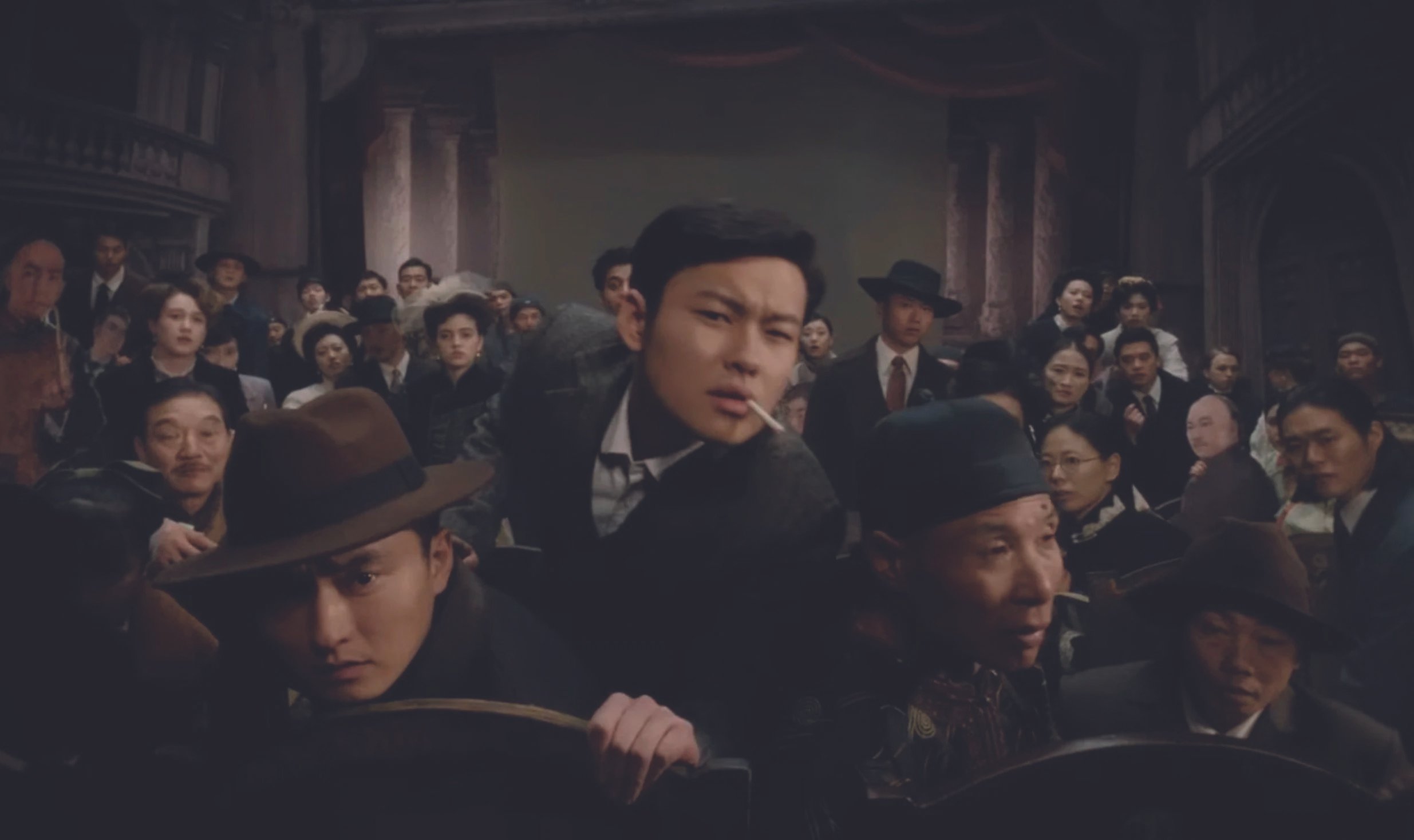
In the Prologue, a curious man and his fellow film audience from a century ago strain to peer at us, their future successors.
The Deliriant, for example, appears as Qiu Moyun in a film noir where he is accused of stabbing a man to death with a fountain pen. He is chased for a suitcase he carries, and although his pursuer comes to learn that Qiu can take other forms, both eventually meet their demise. The Deliriant then appears as Mongrel in a film reminiscent of the Japanese horror anthology Kwaidan (1964). Mongrel is an art thief left alone in a Buddhist temple where he must wrangle with the Spirit of Bitterness (Yongzhong Chen) who appears in trickster form. Mongrel admits to killing his father and is transformed into a dog after performing a Buddhist ritual alongside his unlikely companion.
The Deliriant next becomes Jia in scenes that recall the Hong Kong crime-boss thrillers of the Seventies and Eighties. Jia is a con artist who enlists an orphan girl as his accomplice. Their connection, as Jia learns, is much deeper—he is the father who abandoned her when she was young—but he dies at the hands of the mob as he makes his way back to her. Finally, in 1999, the Deliriant appears as Apollo, a young hoodlum, in a nod to Nineties vampire films. Apollo falls in love with the vampish vampire Tai Zhaomei (Gengxi Li), who returns his feelings, and the two die together as the dawn rises and a new century begins. The Deliriant, too, his senses having been exhausted one by one, dies after this final film death.
Deliriant, appearing as Jia (the name is a homophone for ‘fake’), a con artist, communicates with the orphan girl through hand gestures as they scheme to defraud a wealthy old revolutionary of China’s red ruling class.
Film as art is foundational for Bi Gan’s works. Chinese-born Bi is at once a film director, screenwriter, poet, and photographer. Hailing from Kaili City of Southwestern China’s Guizhou Province, the future auteur grew up obsessively watching films, with an emphasis on American cinema, particularly Hollywood classics. It wasn’t until he was a student at the Communication University of Shanxi studying television directing, however, that Bi began to develop the aesthetic he is now known for. He credits Andrei Tarkovsky’s Stalker (1979) as his biggest inspiration in pursuing filmmaking. This film, he says, showed him that you can craft a film by what is meaningful to you, rather than follow a formulaic style.
Bi has made eight films thus far, shorts and features in equal parts. Kaili Blues (2015) was the first to establish his reputation on the world stage. The story follows an ex-convict who works as a doctor in a rural community and sets off to find the whereabouts of his young nephew. Bi’s preoccupation with time and space—past, present and future comingling—reveals itself. The film won him numerous awards at international film festivals.
But it was his stunning Long Day’s Journey into Night (2018) that served as the turning point in Bi’s career, a work that has been acclaimed as China’s finest art-house film. (See “Creating a Cinema of Dream and Memory: An Interview with Bi Gan by Jiwei Xiao, in Cineaste, Summer 2019, as well as her review of Resurrection on our Website). This romantic noir is told in dreamlike fashion, as memory blurs with the present. The narrative follows a man who returns home after a long absence. His father has died, as has his best friend under nefarious circumstances. While at home, he recalls pieces of his past, which includes a mysterious woman whose memory continues to haunt him. Here, Bi abandons any genre conventions. It is a work memorable for its concluding scene, a single forty-minute take in 3-D.
His newest film, which had its world premiere at the Cannes Film Festival last May where it won the Prix Spécial, shows Bi in full command of his singular artistic vision. Resurrection is difficult to put into words even for those who appreciate it. Visually stunning, nostalgic, captivating, and unique would be among the words attempting to describe what unfolds on the screen. Even those baffled by the film’s narrative acknowledge its visually spectacular qualities. At the end of its nearly three-hour running time, one is left with the sense of beauty and wonder that only a love of cinema can conjure.
Deliriant is a young assassin in the noir episode.
In the Y2K episode, Deliriant appears as Apollo, a hoodlum.
We spoke with Bi for Cineaste at last fall’s New York Film Festival shortly after the film’s press screening.—Shahnaz Mahmud
Cineaste: You are a director, screenwriter, poet and photographer. What were your main influences growing up, and how did that lead you to filmmaking?
Bi Gan: For me, the combination of all the artistic expressions I have done in the past comprise the most essential components of my filmmaking endeavors. For example, the reason I love film is because in considering the composition of the frame, every single shot needs to be presented separately. What I find most interesting is what’s happening outside of that frame, and so I think about all the other artistic expressions I can use to somehow tease out what’s outside of that frame. Poetry, for example, instead of using conventional ways of presenting stories and essays, offers a very different way to think about structure. In essence, poetry is an art form designed to subvert the conventional writing of exposition and sentence structure, enabling you to find a different way to express what you’re trying to present. That is what I do when incorporating other disciplines into my filmmaking. The logic is not one plus one. That is what I want to break away from. I think about what the logic of poetry is and how I can translate that into film. As a photographer, the kinds of visual images that really inform me about the ideal composition is the idea of creating something that will really move you emotionally. All these things are interconnected and reinforce one another. In the end, they serve me in finding a way to create a different kind of film.
Cineaste: Why are you so interested in making films where the narratives transcend space and time?
Bi: It’s something very instinctive. Just like the feelings you get when you dream, it’s something very instinctive.
Cineaste: How did you arrive at the idea for Resurrection?
Bi: During COVID, I spent a lot of time thinking about what I would do for my next project. At first, I had a different idea for what I was going to make—something very personal. But since the pandemic afforded me a great deal of time to reflect, I decided to take a different approach. I wanted to touch on something more macro, for the masses— something collective that humanity is dealing with. I arrived at the idea of a film that would span a hundred years, with the emphasis on what we have been experiencing as a human species. I needed to have a device as the core of the film. That’s when I devised this use of monsters. I then thought that a good way of creating the narrative structure would be to build the character around the five different senses, the sensory channels we use to experience the world. This led me to that aspect of the story in which, one by one, the monster would lose all five senses along the way. That’s how I changed my direction and created a new story based on a film monster.
Cineaste: I believe the title Resurrection is really your main goal in what you want to bring to audiences. Is that correct?
Bi: If I can use a metaphor, it is the Chinese title, the translation for which is A Wild Era, which refers to the one hundred years I was trying to capture. It’s like a box, and when you open it, you find the English title. The core of the film is very much a resurrection, an awakening, that represents the core values I want to present.
Cineaste: You have talked about how your ideas come from dreams, and that visual imagination arises from them as well.
Bi: When I think about these two concepts, dreams and film, I tend to think of both as one thing. For me, I really believe that the two together are the same vessel, reinforcing one another. That’s why I thought that the best way to create this film narrative was through this kind of dreamscape.
What we lost within these one hundred years is not film as an art form, it is our inability to connect our dreams to them. Based on my observations of the reality that we’re living in right now, people have become used to the convenience of technology, like cell phones. Within those cell phones you are drawn to use, you spend a lot of time with apps, with software based on algorithms that can somehow cater to your needs and wants. I believe the time spent on these devices, these apps and software programs, prevent us from experiencing the world in a way that depends on using all our senses in real time with another human being. Nowadays, we spend time relying on limited sensory capacities one uses with a device. In the past, we would have an idea, something in mind we wanted to share with another human being, and we would accomplish such an exchange through interpersonal communication. Today, however, you deposit this information or idea you have to a machine and to somehow rely on big data to process it, so you’re not getting to know another human being. In fact, you’re being harvested and mined as a product and what’s being catered to you is somehow designed to limit you.
Cineaste: Regarding your use of color, you have said that Mark Rothko paintings are a big influence. He has been quoted as saying, “I’m interested only in expressing basic human emotions, tragedy, ecstasy, doom and so on. And the fact that a lot of people break down and cry when confronted with my pictures shows that I can communicate those basic human emotions.” Do those words resonate with you?
Bi: In terms of color, I do think I have been influenced by this idea of using colors intuitively, almost like an abstract painter, to keep it very pure. I’ll give you an example of the different vignettes in the film, especially for the last one, with an uninterrupted take. Since I’m using color to serve the narrative or the story plotline of this vampire-related character, I thought different shades of red would be very appropriate. For the parts of the film focused on the sense of smell, the story of the precocious little girl, Guo Mucheng, with extra sensory perception, I wanted to rely on golden yellow, even when the father character dies. As for the noir segment, that is when the experiences of the Jackson Yee Deliriant character assume a more passive role. Since he is not fully in control and moving the narrative along by himself, I thought a pinkish pale blue fit perfectly for that chapter.
At the beginning of the Y2K episode, Apollo walks through the dystopic world reminiscent of Blade Runner (1982).
Cineaste: I read that originally you were not going to do a long take in this film and then you felt you had to do it out of necessity. People say that with this film’s thirty-minute long take, you are once again pushing the boundaries.
Bi: At first there was a consensus among myself, my director of photography Dong Jinsong, and my art director Liu Qiang, that since we shot long takes for Kaili Blues and Long Day’s Journey Into Night, we felt we had a handle on the craft of the Long Take. We discussed whether it was necessary for us to try to repeat ourselves, to try to one-up ourselves with the same thing, or whether we should try something different. We finally figured that maybe this story could indeed best be presented through one long take, especially since the final chapter was going to have the twentieth century turning into the twenty-first century in one night. Even though these long takes may be expected of me, that technique is nevertheless perfect and appropriate for Resurrection’s narrative.
Then, the next challenge came in terms of the filmic language—how are we going to find a different way to do the long take without repeating ourselves, how are we going to find a new way to push the boundaries of how one can do long takes? Mark Rothko’s paintings became an inspiration for me about how to undertake this long take layer by layer, step by step, and then corner by corner. Somehow, you start to peel off different layers of colors, going from one color scheme to the next in a seamless way. That was what I was trying to accomplish until the end of the film, when you have the purest color, the prettiest one, which is the natural light of the sunrise. That’s what we had in mind to pull something like this off but still achieve something very different from the first two films.
A poker card burning to ashes to test the orphan girl’s supernatural sense of smell.
Cineaste: As a creative person, you seem very self-aware about your growth as a filmmaker and seeing your work in stages. Where are you now and where would you like to be in the future?
Bi: I’m in the process of trying to figure out who I am as a creator, and where I’m going to go. It’s very much like what I said earlier about the noir segment—that it’s pinkish blue, not pinkish purplish blue because I do think that at that point the Deliriant character tends to take a backseat, but he is also thinking about how to move forward, to take full control of his destiny. I think I am at that stage of my career as well. It’s almost like I have been swimming or submerged in the water for a long period of time. Now I want to break the surface of the water and take a long breath.
Cineaste: Can you talk about what may be next?
Bi: It is going to be something very different. It will be a story in another dimension. And it won’t take seven years, probably two.
Shahnaz Mahmud is a writer and award-winning journalist who has worked both in the United States and abroad. She has written for such publications as Adweek, Screen Daily/Screen International, and The Hollywood Reporter.
Resurrection is distributed in the United States by Janus Films.
Copyright © 2026 by Cineaste, Inc.
Cineaste, Vol. LI, No. 2
Quisque iaculis facilisis lacinia. Mauris euismod pellentesque tellus sit amet mollis.