
Bringing African Culture to the World: An Interview with Akinola Davies Jr. (Web Exclusive)
by Paul Risker
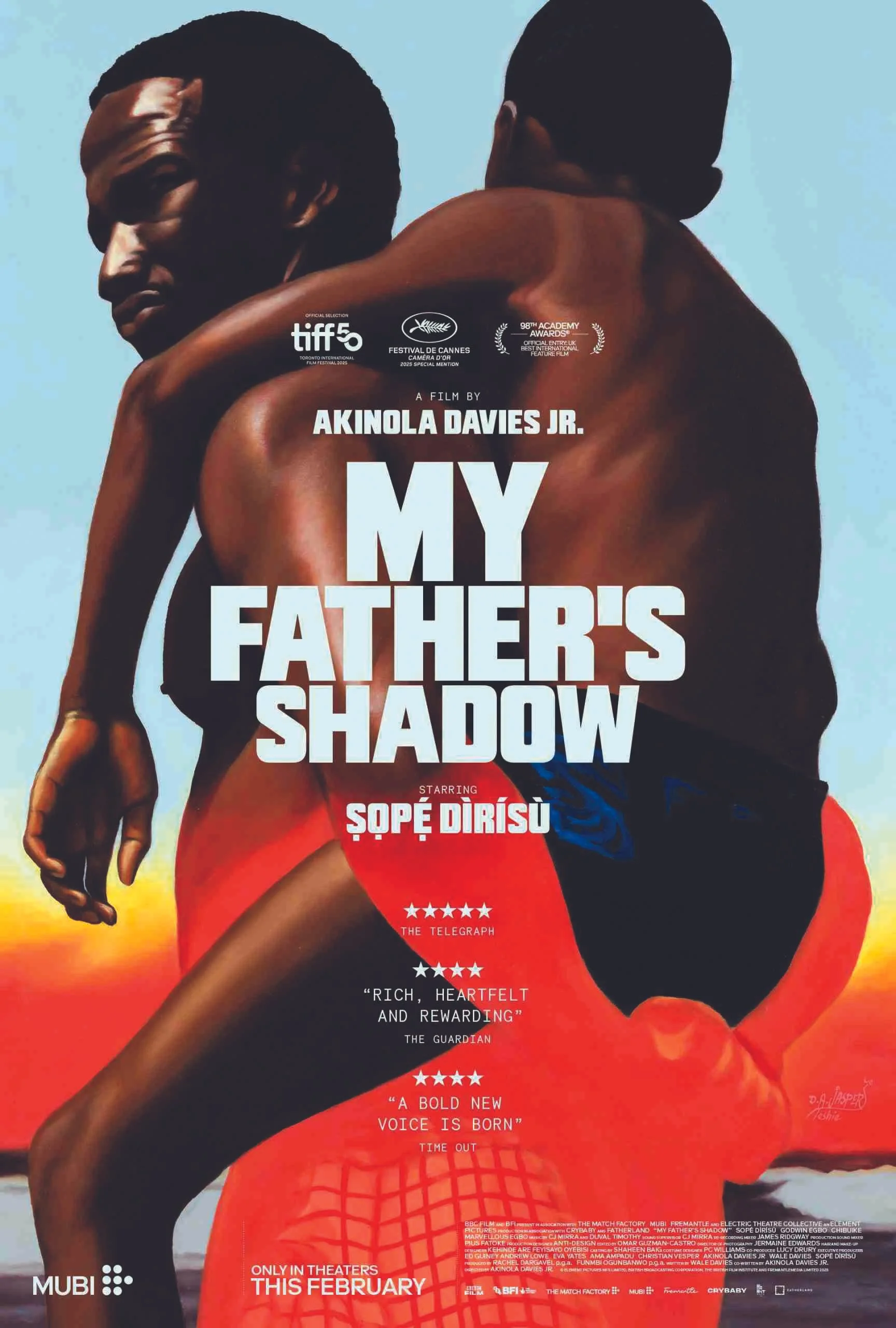
British-born director Akinola Davies Jr.’s directorial feature debut My Father’s Shadow is set amidst the political unrest of the 1993 Nigerian election—the first held in the country since the incumbent government seized power in a coup d’etat ten years earlier. The film opens on brothers Akinola “Akin” (Godwin Chiemerie Egbo) and Olaremi “Remi” (Chibuike Marvellous Egbo) playing outside their rural Nigerian home with hand-drawn cutout figures of American wrestlers. When they finally enter the house, they creep toward their parent’s room. Remi, who suspects their often-absent father, Folarin (Sope Dirisu), has returned, insists on going first. Folarin startles them both when he asks Remi why he didn’t hear him calling. Looking for his watch, he asks if either have seen it and wants to know if they have been playing there.
Folarin breaks the news that he’s leaving for work and that, if he’s to make it to Lagos on time, he has no time to wait for their mother to return from the village. Remi and Akin are upset and remind him they haven’t seen him since the Sallah break—a two-day Nigerian public holiday that marks the end of Ramadan. It’s then that Folarin decides to take his sons to Lagos.
On the small, cramped bus a political conversation develops. Supporters of the Social Democratic Party candidate Moshood Abiola outnumber the one pro-military-government passenger. Remi and Akin listen intently to the anger felt towards the military government and the news reports on the radio that the military deny any involvement in the alleged Bonny Camp massacre ten years ago. When the bus runs out of fuel, Folarin, Remi, and Akin hitch another ride on the back of a small pickup truck. Instead of listening to a heated political exchange, with the wind in their hair, the boys marvel at the experience of crossing Africa’s longest bridge.
Folarin (Sope Dirisu) sits with his young sons Akin (Godwin Chiemerie Egbo) and Remi (Chibuike Marvellous Egbo), momentarily escaping the hustle and bustle of Lagos.
Arriving amid the hustle and bustle of Lagos, Remi and Akin’s attention is drawn to a bilateral amputee, as well as the heavy presence of armed troops that are being transported into and around the city. Folarin bumps into a friend who is lying low after working on the election campaign—four of his group have been killed by the military in the last four weeks. In response to his worry that the military is here to stay, Folarin says, “This regime has to go. They’ve already stolen our future; I will not allow them to steal theirs [his children].”
Visiting his place of work, Folarin hopes to speak with his boss and secure the six-months back pay he’s owed. A colleague tells him that their boss should be back later that day, and so, Folarin spends time bonding with his sons. They visit the amusement park and go swimming at the beach. During their conversations, he opens up about the traumatic death of his brother, who drowned, and how Remi is named after him.
When they return to Folarin’s workplace, the boss has not yet returned. Instead, Folarin accepts his colleague’s invite to dine at a nearby café where they drink wine and watch the announcement of Abiola’s victory. The father’s hopes for his children’s futures are dashed, however, when the military annul the result, leading to chaotic protests on the streets.
My Father’s Shadow could easily have been swept up in the fast pace of its setting, but Davies Jr and his cinematographer Jermaine Edwards have an eye for detail. In moments, the frame rate appears to slow down. This is not only about focusing on details, such as the polo horses that draw the interest of the two boys but also replicates how our gaze manipulates what we’re seeing, especially when we’re curious.
As much as we are guided by the experiences of the characters, a silent, unseen presence haunts My Father’s Shadow. Interspersed throughout the film are observational montage sequences that come to feel like a break in the narrative’s concentration. These will look away from the characters and pick out details of the landscape, including foliage and parts of buildings, and are accompanied by subtly haunting music and sound design. In these moments, whether it is the director or an unseen presence, it’s reminiscent of gazing upon your surroundings, lost in sad, pitiful or melancholic thought about one’s reality. It’s as if Davies Jr. becomes distracted by the anxiety of what he knows will happen and cannot help but momentarily grieve the loss of his characters’ futures.
The director and his brother, co-writer Wale Davies, convey the tension between love and irritation in the father’s relationship with his two sons. He might be quick to anger, but he’s also quick to listen and to learn who his sons are—even when it’s something as innocuous as Remi spitting out the street food because it has onions in it. And Folarin is not the perfect father, but the director and his brother do not judge him. Instead, they love him despite his flaws. And striking is the way the filmmakers choose to allow the characters to reveal themselves rather than to expose them. The audience is privileged to spend time with and learn about Folarin, Remi, and Akin. By the film’s end, we know only a little about them, and yet we feel as though we know so much more. My Father’s Shadow is a deceptively simple film that is less about knowing the life stories of its characters and more about understanding them through an emotional connection.
In a recent conversation, Davies Jr. reflected on sharing his point of view of a city he grew up in, how stereotypes inform people’s world views, and his burning desire for audiences to experience the many stories the African continent has to tell. He also discussed chasing perfection, the role of art in the modern world, inviting the audience to go on an introspective journey, and how politics is at the heart of everything, including Nigeria.—Paul Risker
Folarin (Sope Dirisu), Akin (Godwin Chiemerie Egbo) and Remi (Chibuike Marvellous Egbo) go swimming at the beach, where Folarin shares an emotional moment with Remi, revealing he's named after his late uncle.
Cineaste: How would you describe your relationship to cinema, not only as a filmmaker, but from a personal point-of-view? And what has the experience of making My Father’s Shadow added to any connection you already had?
Akinola Davies Jr.: I’ve learned an immeasurable amount from cinema, which my point of view about before entering the medium was pretty objective. Obviously, I’m a fan of cinema and I love watching what’s happening in the world. It was always, “Okay, that’s what’s happening over there and that’s their experience,” but it started to build these bridges in my mind. My favorite director is Hirokazu Kore-eda, and I’ve obviously watched loads of Akira Kurosawa’s films. And so, going to Japan, I already had an understanding and inkling of the country’s identity.
Particularly with My Father’s Shadow, I’ve seen that cinema is such a powerful tool because, ultimately, it lets people feel seen, but it also shows the similarities between different cultures across the world that we’ve never even experienced. I’ll give you an anecdote. I’ve been fortunate enough to go to Busan in South Korea to screen the film, and the audience was dead quiet. I thought they either didn’t understand it or they didn’t like it. Afterward, they were like, “Wow. We don’t know anything about Nigerian culture, but what we do know is that we have so many similarities having lived under a military regime and dictatorship.” It was the same experience in Brazil.
What I realized in that moment is cinema is the leveler, right? It makes us realize that while our experience is contextually unique to us, people around the world have similar experiences. And the more we can share this and explain the context in which we exist, the more we can build bridges with each other—we can show that our communities, societies, cultures, and histories are a lot more interwoven than the world would make us think they are.
For me, as an ambassador for African and Nigerian cinema, I feel very proud because so many people don’t even understand what the architecture or the geography of Nigeria is. But through my film, they get an opportunity to come to the city I grew up in and actually view it from a perspective that I remember.
Cineaste: There’s a tendency to form opinions based on what we’ve seen or heard before we’ve given ourselves time to develop an informed opinion. This is to the detriment of society and to art and culture.
Davies Jr.: Much of people’s worldviews are completely fabricated on stereotypes, like this idea of the “Other.” In some instances, they may have negative connotations and in other instances positive or more neutral ones. But if you never really allow people to speak for themselves, that’s when stereotypes arise. What I like about cinema is that when a story is authored by its own people, you start to dispel these stereotypes. You start to understand and humanize people a little bit more and start to move away from the idea of caricatures.
Europe and America have developed an eloquent cinematic language and, seeing South America more recently develop theirs, I’m yearning for more African stories. After all, Africa, as the biggest continent, is full of stories, it’s just a case of access and then getting those stories out into the world. I can’t wait for the rest of the world to see the reality of what it means to be from these places and to share in our experience, because that’s also what it means to be African. We’re very inclusive and engaging. We want people to come and visit, participate, and share.
Folarin (Sope Dirisu) takes his sons Akin (Godwin Chiemerie Egbo) and Remi (Chibuike Marvellous Egbo) with him to Lagos. After their bus breaks down, they have to hitch a ride on the back of a small pickup truck.
Cineaste: A director’s first narrative feature is a milestone moment. It’s one you spend so long looking toward and then suddenly you’re on the other side of the experience. I imagine it must be surreal.
Davies Jr.: I haven’t had that question framed in that way before, but it really is. Obviously, in the back of my head, I always wanted to make films, but I never really thought it would be possible because there was no reference point to know how to do so. I’ve been at it for almost sixteen years now and people are surprised that it’s my debut and that it feels accomplished.
I have been working for a long time making short-form things, and I’m a little bit older than some people are when they get to make their debuts. So, I’ve had a lot more worldly experience. I like the idea that making a film is a relationship that requires conviction and resilience and a real commitment to wanting to be part of something. I know people I’ve been at networks and labs with, and we all thought we’d be making our films around the same time. Some of them have made it, but a lot of them haven’t.
I think there’s this idea of wanting your debut film to be perfect, and that creates pressure. If you watch some of the greats, like Peter Jackson, who made a gory film [Bad Taste, 1987] as his first feature, and Christopher Nolan’s was a London no-budget type of film [Following, 1989]. If you speak to them now, I guess they’d say those films are completely imperfect but they had to go through that process of letting go of this idea of perfection, because if you’re going to master a craft, you have to keep going.
My first film might be great, and my second film might be less celebrated. Or I might go through a series that are uncelebrated. But I’m mastering the craft. I’m getting better and what a lot of debut directors or people who are yet to make something need to do is get into the making of it and trust that you’re not doing it alone—you’re doing it with other collaborators, and you need to trust the process. Even if it’s not great, there’s going to be a kernel of an idea in there. I feel as if I’m only just getting started and me and my brother, who is my co-writer, have so many stories to tell.
The one thing I’ve noticed is that film is in a healthy place in terms of world cinema. I’ve seen so many incredible films. A lot of them, about the subject of fatherhood are in conversation with mine, whether it’s The Secret Agent or Sentimental Value. There are so many films with similar themes and topics, and many of us are making interesting works. So, I’m excited about what is to come.
Cineaste: When we begin drawing comparisons between films and seeing which are engaged in similar conversations, this can invigorate an individual film. This tends to be especially true when there are preconceived contrasts.
Davies Jr.: I completely agree because if you gave the same script to directors from different parts of the world, we’d all come up with completely different films. It’s the context and the nuance that makes everything so particular. It is the choices we make as filmmakers. It’s the amount of detail we put into it. For other people, it’s a completely mundane thing, but for someone else, it’s the thing that they obsess over and that’s fascinating.
Where the world is now, art has a big part to play, especially cinema because it’s one of the most consumed art forms. Art is an opportunity because so many people are investing in making a film that feels like it’s about something that has depth and culture. When the world starts going one direction, artists can try to pull it back to what’s important, to what feels more introspective, while trying to hold what’s going on in the world to account through what we feel about subjects like grief and fatherhood. And those connections start to become a lot more powerful when linked together.
Folarin (Sope Dirisu) steers his sons Akin (Godwin Chiemerie Egbo) and Remi (Chibuike Marvellous Egbo) through the bustling streets of Lagos.
Cineaste: My Father’s Shadow appears to restrain itself narratively, remaining structured around a simple premise out of which emerges this personal journey for a father and his young sons. Most of all, the film shows an appreciation for simplicity.
Davies Jr.: The engine of our film is feeling, spirit, and memory and how you capture memory and what memory becomes. People talk about method acting, and I’m not trying to encase my film in hyperbole, but it tries to stay very honest about a feeling of memory and grief, and how those things feel like something you can sometimes latch onto and other times you can’t. Some people might be confused, but ultimately, it’s us really trying to live in that feeling. Also, something we spoke about before is this idea of stereotype. The world needs to be better acquainted with African cinema because most of what happens in our daily existences, especially for the working class, is purely survival. We’re not really chasing each other through the streets of Lagos shooting guns. Most people are just trying to provide for their families and that daily experience, that action of doing, becomes the plot. It’s the human experience.
It is a real exercise in simplicity, peace, and calm, but it is also the challenge of what it means to be human. It’s the feeling intertwined with what it means to be absent or to lose something or the sacrifices that have been made. It’s a film that allows us to sit in the here and now and take stock and be a lot more understanding of our lived experience, of our parent’s experience, of sacrifice, and the trade-off in any decision you make. From speaking to me now, what could you be doing that you’re not doing? It’s that personal context and I think everybody can relate to that on some level. With this film, we were just trying to give people an opportunity to have a dialogue, or to have space to think about and engage with their inner thoughts and the trade-offs they are having to make in their lives.
Cineaste: Picking up on the politics of your answer, is everyday reality one where you cannot separate the personal from the political?
Davies Jr.: To be a human is political, and some people might feel like they don’t have to participate, but everything leads back to politics. I think in a world where, for right or wrong, politics is becoming so prevalent in our everyday lives, it may not give us the time and space to think of ourselves and how we’re actually genuinely responding to things. It doesn’t give us the time to think about what we want for ourselves, including the future we want, and how we want to live versus how we used to live. So, it all feeds into the work.
Nigeria is a completely political concept. We’ve lived through coups, military dictatorships, and juntas, and we have just transitioned to democracy. To be Nigerian and to experience the life we live is irrevocably political.
With time to spare until he can collect the six-months back pay he is owed, Folarin (Sope Dirisu) bonds with his sons Akin (Godwin Chiemerie Egbo) and Remi (Chibuike Marvellous Egbo) at an amusement park.
Cineaste: My Father’s Shadow subtly speaks about that transition from being young and feeling like you have the world at your feet, to realizing the time left is shrinking. This comes through the father’s relationship with his sons, specifically the time he has lost out on. The story is one that nudges us to consider both how we should value the time we have to create memories and the ease at which we grieve what we’ve lost.
Davies Jr.: Nothing in this life is guaranteed, and a lot of the time we wake up every morning and do the same thing. Or, we might do something different, but we don’t take stock of that. It’s really important to remember that not everyone is fortunate enough to have the experience of living life. What I really enjoyed in the process of making this film was just this idea of showing gratitude and having an intergenerational conversation, if and where you can, because so many from the older generation didn’t have the care of thought to be able to think this way or engage in their own history and mysteries.
So, a lot of what I really love about this film is just this idea of holding space for others, not to glamorize it or say one aspect is more important than the other, but just present the idea of sacrifice, which I keep mentioning. To some people, it might resonate more than with others, but it’s that balance of what’s lost versus what’s to come, and how do you manage that space? But I think if people aren’t cognizant of being allowed to think that way, then they don’t. You have to do some groundwork to encourage them to see themselves in a different light.
Cineaste: Thinking back on how cultures are intertwined, it’s interesting how the west has held itself up with a sense of superiority, and yet now we’re witnessing the inherent vulnerabilities of our cherished democracies. Listening to you talk about Nigeria’s history and watching My Father’s Shadow is humbling, because, again, it allows us to consider that the perception of geographical divides has oversimplified our cultural worldview and fostered a naiveté if not indifference or arrogance.
Davies Jr.: The world has always been a fragile held-together idea. You were speaking before about loss of memories. The point when you realize you’ve lost something, might be too late to pull it back. That’s why it’s important for everybody to stand up for what they really believe in and just communicate what’s important to our existence.
The moment you take your eye off the prize is the moment you start getting tricked. In an African context, we’ve been tricked for so long by many of our own leaders, something in which the global world order has often participated.
I was going to say the geopolitics of the world is always intermingled, and we’ve been for so long at the cusp of a fragile democracy and always been looked down on for not fighting enough for and realizing the value of what we have. But the context of how we’ve arrived at that has always unfortunately been in the context of violence. Our parents and their caregivers and us, even as kids, we’ve seen so much violence that we don’t want to see any more of it. But for all that we went through, we’ve never really spoken about it. That’s why, in this day and age, it’s important to have conversations with those that have come before, to understand what happened in Europe and America in the Sixties through the Eighties, so that we’re not rehashing the same problems.
What social media, smartphones, or the current access to information have given us is a means to reference all this history, and to remember things. But I think a lot of it is playing on people’s worries and fears as opposed to using it as an opportunity to have those intergenerational conversations.
In the U.K. in the Eighties, for example, the decade in which I was born, what happened to the miners and the working class are now events two, three, or four generations removed, and they are still being oppressed. But they’ve been oppressed in a way that now leads to pointing fingers at everyone else instead of pointing a finger at the institution and the politics that are supposed to be taking care of them. The welfare state was supposed to be an opportunity for people who fell through the cracks, but that has now been dismantled.
It is the state that is supposed to be taking care of the people. What’s important is that the people in our film, and in all these other films, are the most important resource a country has. These films should remind people of the power they have, to remind them of the history and legacies they’ve shared. That becomes a starting point for the conversation of who we want to be and the way we want to see the world moving forward. If we don’t engage in our histories, and if the younger generation doesn’t repurpose that history to show ourselves, then we’re just going to end up falling through the same cracks and fall for the same tricks as before.
Paul Risker, a U.K.-based film critic and PopMatters contributing editor, has written for numerous periodicals.
My Father’s Shadow is distributed in the United States by MUBI.
Copyright © 2026 by Cineaste, Inc.
Cineaste, Vol. LI, No. 3
Quisque iaculis facilisis lacinia. Mauris euismod pellentesque tellus sit amet mollis.