
Deconstructing Chronicles of the Absurd (Web Exclusive)
by Miguel Coyula
When my 2024 documentary Crónicas del absurdo (Chronicles of the Absurd) won the award for Best Film at the Envision Competition at the International Documentary Film Festival Amsterdam (IDFA), festival director Orwa Nyrabia commented, “Chronicles of the Absurd is an experimental film, but experimentation here doesn’t come from a position of privilege, it comes as necessity.” Afterward, I spoke to a Cuban film critic who was very enthusiastic about conducting an interview. He had many questions, so I began to prepare by writing notes. Several months went by and the written questionnaire never arrived, so I decided to use my notes to chronicle the creative origins of the chapter of my filmmaking that I hope I am now closing.
In 2011, I offered actress Lynn Cruz the lead role in my sci-fi film Corazón Azul (Blue Heart, 2021). It depicts the results of a genetic experiment conducted by Fidel Castro to create his vaunted “New Man” that would serve as the beacon to his utopia. The experiment goes wrong, however, and these individuals grow up to become terrorists who begin to destroy their creators. Obviously, this premise for a film would never be greenlit by the Cuban film industry.
Lynn Cruz as conflicted terrorist Elena in Blue Heart.
The project would take ten years to complete while shooting in a clandestine manner. Chronicles of the Absurd is a chronological account of the obstacles we confronted during this period while working outside Cuban institutions. I was always a deliberate outsider. For Lynn, however, working in this manner meant renouncing her previous career as a critically acclaimed and award-winning theater and film actress, since during the production her cultural life and work relations were gradually devastated by the state through police raids, a trial, a home inspection by government officials, state security interrogations, and medical negligence, to name just a few vindictive responses.
One common approach is to define Cuban Independent Cinema as you would in any nontotalitarian country. The minute you have ties with a Cuban institution, however, whether it’s requests for funding, international co-production, or permits, your project and script must be approved. There is also a long list of subject matters that are prohibited. No matter how clever filmmakers might think they can be in realizing their vision, negotiations must take place not only with bureaucrats and censors but also at times with themselves, even if in an unconscious manner. Many artists who chose exile later argued that in Cuba it’s impossible to create with freedom. I chose to live in Cuba and continue to create without ties to any institution, although often at great personal cost. But don’t mistake this posture for any kind of heroic nationalism. This manner of producing under the radar, without institutional funding, is the only way I´ve known to produce my films without compromise. It might be difficult, but I don’t take any pride in that. Chronicles of the Absurd is an ugly film because of its relentless confrontational nature. I wish I didn’t have to make it. But obstacles are often the source of new ideas, and the film could only have been documented in this way, especially since it was created mostly with clandestine audio recordings.
In any case, it doesn’t really matter what I think of the film. Once a film is out, audiences own it. Cuba’s population are often two-faced citizens—private and public—when it comes to politics. This defense mechanism has been a common behavioral staple of the last sixty-seven years for a great many citizens to survive without becoming declared an enemy of the state. It is so imbued in the Cuban psyche that it is often devoid of any ethical self-questioning.
The clandestine audio recordings are sometimes the only way to elicit a genuine understanding, often in places where video recording is not allowed, or where a camera would significantly alter behaviors. Chronicles doesn’t aim to be a multilayered, visually ambitious work like my previous narrative features Memorias del desarrollo (Memories of Overdevelopment, 2010) or Blue Heart, Form here serves mostly to illustrate and clarify the content, sometimes adding irony, while occasionally contradicting it.
As I explained earlier, this is not a film I would have decided to make. It just fell upon us as a necessity. Aside from the challenge, I made it because I felt a responsibility with the material, believing it could contribute to understanding what it is like to create outside any Cuban institutions, whether in the island or abroad. The absurd propels its narrative beyond political stances. Coming from a world of fiction, this was perhaps the one aspect that drove me to make it. I have an affinity for genre filmmaking, and Chronicles might also be considered as a dystopic political thriller or a psychological horror film, with a great deal of humor.
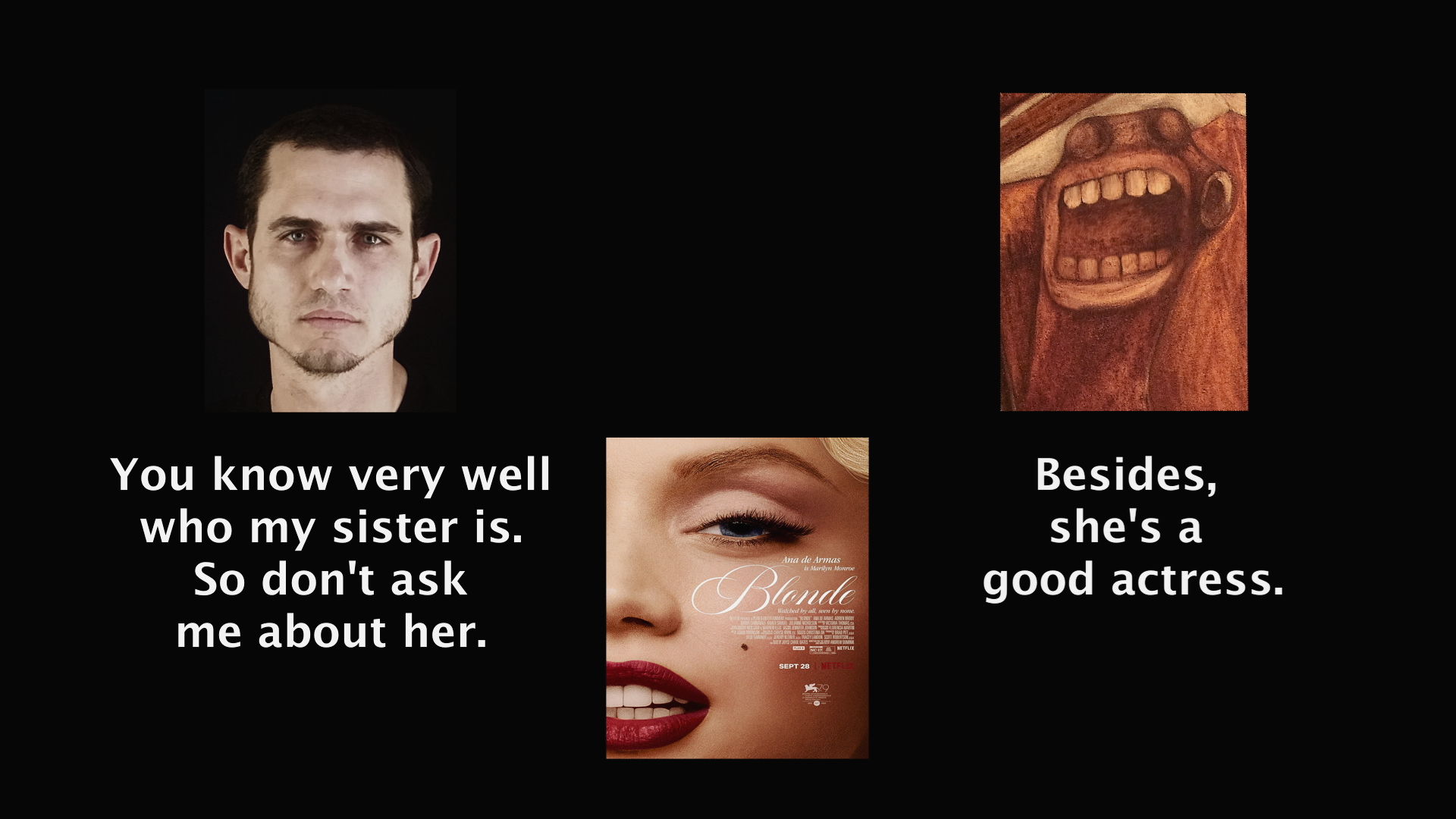
After taking stills of the making of Corazón Azul, photographer Javier Caso is interrogated by Cuban State Security Agents about his sister, actress Ana de Armas.
I also wanted to make it in Cuba. A few exceptions aside, an increasingly common thread for Cuban filmmakers is to acknowledge political discomfort only once they leave the island. Some even go so far as rewrite their personal artistic history to present themselves as censored dissidents, when all their work was either co-sponsored or approved by the Instituto Cubano del Arte e Industria Cinematográficos (The Cuban Institute of Cinematographic Art and Industry, hereafter ICAIC), with all the filtered content this implies. There is something dysfunctional about going to live in another country and, instead of absorbing the new culture, to make the films they never dared to make while living in the island. I’m not necessarily talking about cowardice or opportunism. I have experienced how comfort can impede one from fully exercising their abilities. If you are interested in creating art that revolves around discomfort, you must weave it as an organic element into your narrative. You most befriend this notion of discomfort as a powerful weapon. In my case, it might not be a good recipe to live by, but I personally find danger, both emotional and political, as beneficial to creative work. Let alone the fact that the Canary Islands, Santo Domingo, or San Juan don’t look like Havana.
In 2022, a colleague living in Miami encouraged me to apply for a scholarship awarded to artists at risk. It was a generous amount, but it meant I had to be in Miami for several months. I refused. I didn’t want to be labeled as an “artist at risk.” It’s true that I’m banned, and can’t work officially in this island, but that pales next to the reality of political prisoners in Cuba. Recently, a colleague who immigrated to Europe was awarded a fellowship given to filmmakers at risk. He was never at risk in Cuba to begin with, so how can he be at risk now after living ten years abroad? I would think that in this age of the Internet, transforming your history would be a little more difficult than in the analogue age. But even with all the information available online, few do research there simply because hardly anyone loses sleep over transforming their past. The post-truth notion that many politicians exercise seems to have expanded to artists as well. While it is true that a few dissidents are not allowed to return to Cuba, others decide not to do it out of dignity, and most out of fear. While self-exile grows ever more popular, there is also a reverse side that caters to an audience lingering in the exotic romanticism of “Made in Cuba,” which truly means “Made inside the Revolution.” Many of these artists, whose work is not overtly political, have moved abroad for reasons other than censorship, while claiming, years after, that they still live in Cuba. Such dislocation could be blamed solely on a government responsible for creating individuals who lead a double life as the only path to succeed or survive. These artists have embraced the game of personal branding, both in and outside the island. They live under a structure where being Cuba is still heavily categorized, sometimes leaving them without any other choice but perpetuating dislocated identities.
The truth is that Cuba hardly matters anymore. Fidel Castro, creator and leader who branded the revolutionary epic, has been dead for a decade. The current president scarcely has any power as he merely represents the socialist facade for a decision-making military collective that runs a low-budget state capitalism. What happens to artists in countries like Iran is much more severe. There are dictatorships like that under which punishment by death is common, while in Cuba psychological death predominates. While it is wrong to compare the two, the first will indisputably be more newsworthy than the second.
The Narrative Construction of Chronicles
Aside from the silhouettes at the beginning and end, the entire film is constructed with archives, including audios, logos, photos, film posters, and some video excerpts. I refused to use crowd-pleasing elements such as interviews or voice-overs. I didn’t want to guide the film with our own opinions about events. It was more important to just document these events, which alternated between horror and humor. It would have been too easy to emphasize personal victimization, but we didn’t want to exploit ourselves as characters in that manner. There are people in this island who are worse off than we are, and pain shouldn’t be used as a comparative measure.
At first glance, you might think Chronicles of the Absurd is just another “human rights movie” made in post-Castro Cuba in the usual Artist vs. State fashion. But the inclusion of Chapter Seven, “Antihero,” was crucial to make the film’s political reading more complex. This chapter features the presentation of my 2022 novel La isla vertical (The Vertical Island) at a panel discussion in Spain by an emigrated visual artist who was adamantly critical of the novel but still vehemently insistent on presenting it. I used I have always searched for contradictions in the protagonists of my fiction films. This time, Lynn and I were the protagonists of our documentary, but I did not want the film to be a Manichean narrative of heroism against oppression. That’s not interesting to me, neither in life nor in film. Whether in a fictional narrative or a documentary, heroes have never been my favorite protagonists.
Miguel Coyula as a terrorist leader in Blue Heart.
In similar fashion, earlier in the film, in Chapter Two, Lynn gets fired from the Performing Arts Artistic Agency (ACTUAR), a Cuban government talent agency because of her published critique of politicians, something that had nothing to do with her work as an actress. I thought of mirroring this chapter with the Spanish panel’s book presenter who was so politically insulted by the depictions of minor characters who appear on only two pages of my novel that he had nothing to say about the plot or the protagonists. As a post-apocalyptic novel, The Vertical Island explores the darkest depths of the human heart through its protagonists. But the secondary characters criticized by the presenter were based on Cuban opposition activists, in this case a handful of people with whom the presenter identified or was affiliated. His personal reaction to the novel might be legitimate in that regard. But if baffles the mind as to why you would agree to present a novel that you hate. That is, unless you do so because it enables you to defend your cause. And if a political cause is the most important thing in your life, then you are buried as an artist.
That’s often a problem found in activism. When either a cause or a person becomes a point of personal identification, it often sets in motion political machinery that disables individual critical thinking. As a last desperate measure, and in true McCarthyist fashion, the emigrated visual artist presenting The Vertical Island resorts to reverse ideology by stating, “If you are a communist and love Fidel Castro…you will be eaten alive in Miami.” At that point, I illustrate his comment with a photograph depicting a group of screaming Cuban Americans holding a sign that reads “Cubans for Trump.”
Emigrated visual artist Lester Alvarez during the presentation of The Vertical Island in Madrid.
That is perhaps the most transgressive element in the film. Many people know about the dysfunctionality of the Cuban regime, but it’s not often that you will also find the dogmatism of a reverse ideology represented within the same film. It’s here that Chronicles becomes politically complex, since this chapter has met vastly different reactions. For some people, the presenter could be considered either as a righteous savior, a fanatical inquisitor, or a pretentious fool. Depending on a viewer’s perspective, I could be perceived as either the voice of reason, a self-absorbed artist, or a downright villain. I have no problem with any of those characterizations. Just as I do in fiction, I assume myself as a character living in a dynamic situation where contradictions are welcomed. The nihilism of the film does not serve any cause other than its premise of absurdity. In this tableau, the political convictions of many of the film’s government antagonists often make them behave in a seemingly irrational manner that adds to the humor of these exchanges. Horror cannot fully exist without a dose of comedy, depending on the sensibility of the viewer.
My previous documentary is linked to Chronicles in the sense that it also favors spoken language as opposed to visually driven narratives. But they are also vastly different. Nadie (2017) is essentially a testimony by an eloquent subject. Chronicles lays the facts out before you. There are no interviews to contextualize or reflect on them. It’s up to the audience to interpret them.
I thought Lynn would be a much more interesting protagonist. I have always operated outside of the system, so I have no true narrative arc, but you see her going from initially winning professional recognition at ICAIC to gradually being fired and harassed in escalating intensity that equals her passion. Her narrative arc is much more interesting than mine. Yet, at the same time, I feel the complexity of the film’s structure is limited by depending only on archival material. Save for Chapter Five, “Father,” for example, there are few intimate moments in the material, which, although perhaps elevating it emotionally, would have been at the expense of betraying its nature.
The Visual Aesthetic of Chronicles
The aesthetic of the film is organically born out of necessity. Many of the audios were made by recording with concealed cell phones, sometimes at the bottom of a bag. Rather than attempting to clean up the audios and create a sound design, we felt their roughness added an element of tension. Many of these exchanges involve several people talking and overlapping one another, so it was necessary to create a graphic layout that would identify multiple speakers.
As for the visuals, I wanted them to be as austere as possible compared to my earlier films. Here we have a black void as a canvas, where several photos or animated illustrations by expressionist artist Antonia Eiriz are combined with graphic transcripts which enhance the subtleties of the exchanges. As with my documentary Nadie, Chronicles is also a film about verbal language.
Gorki Águila sings in Chronicles of the Absurd.
Visual and aural eclecticism has always interested me as a way to disrupt the rhythm and narrative expectations of a film. I sense the mood of the previous episode to determine the manner of bridging it with the next. The beginning of Episode 5, “Father,” has electronic music by Jonathan Formell that emphasizes garbled speech distortions, which serves as a bridge to the chaotic nature of the upcoming episode, and the uncertainty of a recording made with a cell phone hidden in a bag. Chapter Five also switches the narrative by extending its absurdity to the personal level. When Lynn’s father is experiencing agonizing pain in a hospital due to medical malpractice, the doctor responsible is strangely absent as is the rest of the staff. The reason is never clarified. Since Lynn publicly denounced what happened, the government, by way of response, made a podcast praising the medical skills of Dr. Yuniel Bravo, therefore providing closure to the episode.
Lynn Cruz in Chronicles of the Absurd at the end of chapter 5.
Part of what greatly motivated me to create the film was the challenge to see if it could hold an audience’s interest with such an “anticinematic” format, if we understand cinema as moving images. Within the black screen we usually have six windows used for avatars, images of the characters that become visible only when they speak. If they are mentioned, they appear in black and white. The choice of Eiriz’s paintings came naturally since we couldn’t find photos of many of the antagonists who are not public persons. In the case of the government agents, we don’t even know their real names, so Eiriz’s monstrous abstractions were ideal to depict their relative anonymity. The paintings are animated only minimally so they won’t detract from the words we see on screen. This aesthetic was partly inspired by 8- and 16-bit RPG video games and their limited capability for full motion or aural speech. Occasional animated actions are executed at fifteen frames per second, creating an intentionally jittery movement designed to mimic the equally unpolished audio quality. It is frame-by-frame animation; even in the simplest movement of still pictures. Full-motion graphics would have provided predictable mathematical precision and thereby harm the sense of unpredictability and chaos in the narrative.
The aesthetic aimed at a balance between rhythm and verbal information. Sometimes dialogue comes at you very fast, and sometimes it is hard to understand because a cell phone was concealed in a bag and the sound is muffled. Verbatim transcripts illustrate the exchanges in a graphic manner that emphasizes excitement, hidden meanings, and ironies. Antonia’s monsters come back also in Chapter Seven, albeit in a different light. This time not to represent real people but to refer to fictional characters in The Vertical Island. Here it is used to reinforce the struggle of the emigrated Cuban presenter to separate fact from fiction.
Sound and Music in Chronicles
The editing uses no dissolves or any kind of smoothing. Hard cuts are synced with precise fastidiousness to words, sometimes even syllables. Speakers appear in a black void only when they speak. But this military discipline, which could seem like AI, is adapted and transformed according to the context of each episode. If any beauty is to be found, it is in the wordless interludes dividing the chapters, which are meant to provide time to process, bridge, and contextualize the elliptical narrative. The only sound design in the film is also contained in these brief wordless moments. Music in those sections is courtesy of Porno Para Ricardo, a Cuban Punk Rock band, Sentimental Idiots (a Russian Rock Band), and “Adiós a Cuba,” a classical piano piece by nineteenth-century Cuban composer Ignacio Cervantes.
The eclectic use of music was intended to serve primarily as interludes to create a dramatic structure. After the police raid for the documentary Nadie and the play Enemies of the People, we hear a segment of Ignacio Cervantes’s “Adiós a Cuba,” a piece composed by Cervantes in 1875 when he was forced into exile, hence the title. While Lynn and I still live in Cuba, she was saying goodbye to her professional life, her colleagues, and even friends who walked away from her after she was censored, becoming an exile while still inside the island. This classical piece precedes the harsher segments of the film where rock music shatters the narrative. For example, the climatic musical closure of Chapter Three, “Alternative Film Festival,” anticipates what’s to come in Chapters Four and Five. The prologue features the instrumental segment of Porno Para Ricardo’s song “Peste a Rata” (“Stinks Like a Rat”), which is interrupted by the blackout, and we only hear the song’s lyrics in Chapter Eight, “Punk Musical,” toward the end of the film.
Public Reception of Chronicles
The Best Film Award at IDFA’s Envision Competition was a surprise. I thought I had made an interesting auto-ethnographic documentary, but I didn’t think it deserved a Best Film Award. We were then invited to the Ismailia International Film Festival in Egypt. The film was not subtitled in Arabic. The audience’s response was nevertheless enthusiastic. “We are living the same predicament here!” We understood then that the festival programmers probably used the film to refer to the reality for artists in Egypt, which, had it been an Egyptian film, would have been censored or never made at all. The United States premiere at First Look at the Museum of the Moving Image in New York was equally revealing. Ben Burton, writing in Impulse Magazine, said Chronicles is “about the impact of using technology and art as a medium of imagination and trickery to express truth…This is not a didactic treatise, but a record of circumstances, a reflection of the reality for Cuban artists. This makes the film both incredibly specific about life, art creation, and politics within Cuba but an equally poignant testimony to the reason why film is such an essential medium.” In Gay City News, Steve Erickson noted that the film “seems less foreign after the Trump administration’s takeover of the Kennedy Center. Even in authoritarian societies, the arts have been a means to speak about undercurrents of unease and rebellion.”
Days later, the Miami Film Festival was an entirely different ordeal. During the Q&A, Lynn commented on her growing tension while going through customs upon entering the United States. She was met with an antagonistic scream from an audience member, “This is the best country in the world!” To which she replied, “I’m tired of charismatic leaders.” About a dozen people stood up and left. While the film was reviewed several times at the First Look Festival, nothing was written about it in Miami, the city with the largest population of Cubans outside of Havana. This was not unexpected since the Miami Film Festival had rejected every one of my previous films, despite the fact they had been shown everywhere from the Sundance Film Festival to the Moscow International Film Festival. Curiously, the response at the Miami Film Festival mirrored the film’s reception inside the island where no critic has written about it.
Chronicles was also invited to Le Gran Vibouac documentary festival in France. On March 2nd, 2025, its director of programming, Jean Sebastien Esnault, sent me an email stating, “Thank you for this fabulous, amazing, committed work. What an extraordinary gesture of cinema! It would be an immense honor to welcome you here in the city of Albertville between 13 and 19 October 2025.” As I was completing the French version of the film, I wrote back to him several times only to be left in complete silence. What had happened behind closed doors that led the festival to withdraw the invitation? This is not the first time something like this happened to one of my films, but it is the first time it happened in France.
In September 2025, Lynn and I were invited to screen the film at several universities in the United States. But the Trump administration determined that her VISA wouldn’t be valid for such cultural exchanges, and the U.S. Secretary of State Marco Rubio was the only one who could authorize exceptions. As a result, Lynn was forced to attend a screening of her own film and remain in the audience. Rubio, the son of Cuban immigrants, probably wouldn’t have made an exception anyway since Trump appears briefly in Chronicles of the Absurd.
In Cuba, the film is not only banned—since I don´t belong to any institution—it’s not even part of the discussion. As with my previous films, we do screenings for small groups at home, which we cannot advertise online.
Closing Thoughts about Chronicles
I do not think this is my best film by a long shot. But we had to devise an aesthetic that, given our limitations, would successfully marry form and content. All audience reactions are similar—shock, anger, and laughter. This does not surprise me. I like films I would see more than once. I cannot feel the same with this one. Sure, it’s gripping, occasionally hilarious, and rhythmically breathless, but I don’t think that, beyond the initial shock of its content, it truly lingers in your mind. True beauty always possesses drama, as poet Rafael Alcides states in Nadie, but I think it must also have a potent dose of everlasting enigma. The bluntness of the film rarely allows moments that contain this kind of fleeting beauty. Many have told me that these kinds of remarks should be left for people who are critical of the film, but I think honesty is crucial to confirm the true nature of art. In any case, what I think of the film is irrelevant. After it is out, it’s up the audience, and not a word I say should matter. A colleague recently told me that maybe the film’s beauty is akin to Eiriz’s paintings.
Lynn Cruz argues with Cuban State security agents in Chronicles of the Absurd.
During a presentation of Nadie in Paris, film historian Paulo Antonio Paranagua quoted Alberto Calvacanti by stating that “without experimentation, documentaries lose meaning. Without experimentation, a documentary ceases to exist.” I wouldn’t go so far as to expect or demand that of every filmmaker, but I do agree that, as a personal creative act, any film I make isn’t significant for me unless I can experiment in a new direction. There comes a point in life when artists who were once radical discontinue their desire to expand the language of their respective disciplines and eventually become more conventionally accessible to the majority. They can still create solid work, but it grows out of their previous achievements. As I grow older, I feel that the drive to pursue a different direction each time needs to be reignited. Risk must be involved both in form and content. I feel I’m working with such a level of freedom that it would be a waste to do otherwise.
By the late 1970s, Ingmar Bergman, master of existential anguish, came slightly closer to make a political film. The burning monk in Persona (1966) was a brief political reference to a real-world event in what is probably his masterpiece, and one of the only instances in which he inserted documentary footage into highly stylized imagery. His most openly political film, The Serpent’s Egg (1978), is among his least successful works. While he considered himself a Social Democrat, he declared he was not politically involved and did not want to favor one political attitude over another, save perhaps for his support of Hitler in his early youth. I’ve heard the argument that he could afford to do existential ennui because he lived in a first-world country where day-to-day survival was much less of an issue. Some artists take sides when it comes to art with political content, while others favor neutrality. My strategy is equality in demolishing returns for all sides involved in a conflict.
My first feature film, Red Cockroaches (2003), was shot during a scholarship at The Lee Strasberg Theatre & Film Institute in New York City in 2001. At that time, I sought leaving the island. I wanted nothing that would tie me to Cuba. Since I had a particular affection for science fiction and dysfunctional characters, Red Cockroaches was born. Afterward, from the distance, I realized that Cuba was fertile ground for a great deal of dysfunction. It was also a landscape I knew and I felt it would have been a waste not to make a film about a taboo subject there since guerrilla style was the only way such a film could exist. I returned to Havana to shoot some scenes for what would become my second feature, Memories of Overdevelopment. Afterward, I decided to shoot Blue Heart completely in Cuba. It wasn’t patriotism; it was made as an ultimate challenge, not to the government, but to myself.
Today, I feel that I’m witness to the closing of a chapter of Cuba itself. For me, the real challenge now is to see if I can I make an existential film that is devoid of overt politics in this collapsed island. It’s worth a try, although I fear I will soon have new targets in the shape of politicians, which sadly I won’t be able to ignore.
This brings me back to the awards Chronicles has received during its festival run. A part of me felt bad, imagining that it they were awarding its shocking content, as a reward for the pain we experienced. But as poet Rafael Alices used to say, the heart is a scoundrel, it sometimes betrays you. I do understand the format of the film is different.
Something shifted during the pandemic. Life seemed to somehow lose its meaning for many. Some fear being replaced by AI. I think AI is a useful tool, but it can't compete with the most radical art, simply because it's a vast accumulation of information; it has the capacity to relate that information, but it lacks the capacity to innovate. Artists' rejection and fear of AI perhaps stems from the fact that we already knew something before its proliferation. We already knew it was very difficult to conceive of something new in art. Many felt we were recycling the same stories, images, and sounds, under a novel lens, often cooking them with a new combination of ingredients. AI has made this widespread feeling evident. Hollywood filmmakers working on commercial films will certainly face a challenge since they are perfecting the formulas most widely disseminated by algorithms, that’s why experimentation is the only way to move forward.
Blue Heart and other films by Miguel Coyula are available for streaming at Habanero Film Sales. Chronicles of the Absurd will be available for streaming by the late 2026.
Coyula’s YouTube site is at here and his LinkedIn site is here.
Copyright © 2026 by Cineaste, Inc.
Cineaste, Vol. LI, No. 3
Quisque iaculis facilisis lacinia. Mauris euismod pellentesque tellus sit amet mollis.