The Twenty-Eighth Thessaloniki Documentary Film Festival
by Darragh O’Donoghue
This year the Thessaloniki Documentary Film Festival (TiDF) celebrated The Archive (capital ‘T’, capital ‘A’). The festival trailer celebrated the casual daily records of today as the archives of the future. The main retrospective strand All the World’s Memory focused on the type of documentary alternately labeled the compilation film, found footage film, or archive documentary—works that take moving images from the past, found in public and private repositories, flea markets, or, increasingly, on the Internet, and arrange them into new narrative or ideological contexts. The season was accompanied by a catalogue with texts inspired by the primary philosophers of The Archive (Benjamin, Foucault, Derrida) and included reprints of texts by two of its most influential film theorists, Catherine Russell and Jaimie Baron; a second, related “non catalog” was entitled Unarchived. Bill Morrison, often celebrated as an “archivist” or “archaeologist” of the cinema for his found-footage artworks, was awarded an honorary Golden Alexander for lifetime achievement. And, despite the increasingly formulaic and “official” nature of films rooted in the archive—as called out in the catalogue text “Why I’m Fed Up with Archive Art” by artist Alexandros Psychoulis—many of the new films in the international competition and other festival strands continued to rely on repurposed imagery.
The festival trailer directed by Steve Krikris showed two young people of today, recording their lives on smartphone in and around the dockland area of Thessaloniki where most of the festival took place. These are lives energized by sunlight, movement, idiosyncratic personal style, and joy. Their yellowing footage is screened a century later in what looks like a basement, watched by an impassive audience standing with VR-type headsets. This is an imagined future world of artificial light, stasis, uniformity, and emotional frigidity.
Festival trailer - the 'future'.
It is not clear what message this trailer is supposed to convey. Why is it a good thing to create so many records of today if the future is so oppressive? Perhaps the roots of that bleak future are in a bleak present that is not noticed by the fun-loving youths, but which will be amply identified by the films shown in the festival? Perhaps the culture of an apparently utopian past will inspire future malcontents, as so often happens in dystopian fiction? Trailers are a form of advertising, a medium that can be direct and unambiguous, informing potential patrons about what they will get for their money, or can provoke their desire with mystery and fiction—qualities that are often absent from the “say what you see” genre of documentary. Have the advertisers hired by TiDF botched their message—what exactly is it they are selling? Or have they cleverly created an atmosphere of anxiety and unease about the theme of The Archive that would be further explored throughout the festival?
Despite the homogenous concept of The Archive indicated by its capitalization, it soon became clear in the festival proper that there was no consensus as to what The Archive actually is or means. This is unsurprising as The Archive is a theoretical construct utilized by people who—as Psychoulis pointedly remarks—have no training or experience in actual archive work. The only professional archivist who contributes to the All the World’s Memory catalogue is Amalia Pappa, Deputy Director of the General State Archives of Greece; her text is a practical discussion of her own service, its origins and functions. In brief, there is a disconnect between theory and practice (or, as the theorists like to put it, “praxis”).
Simply put, archives are either repositories that hold historical records, or discrete collections held in such repositories. Traditionally, records were instruments of power, the means by which governments exercised control on populations—census records, taxation documents, court records, land registers, and so on. Those hostile to oppressive regimes often destroyed archives for this reason, although such attacks could have disastrous consequences for the collective memory. The most powerful films in the All the World’s Memory strand were those that recognized the centrality of power to the archival project and mounted an oppositional attack on it—an ideological attack, of course, rather than a material one.
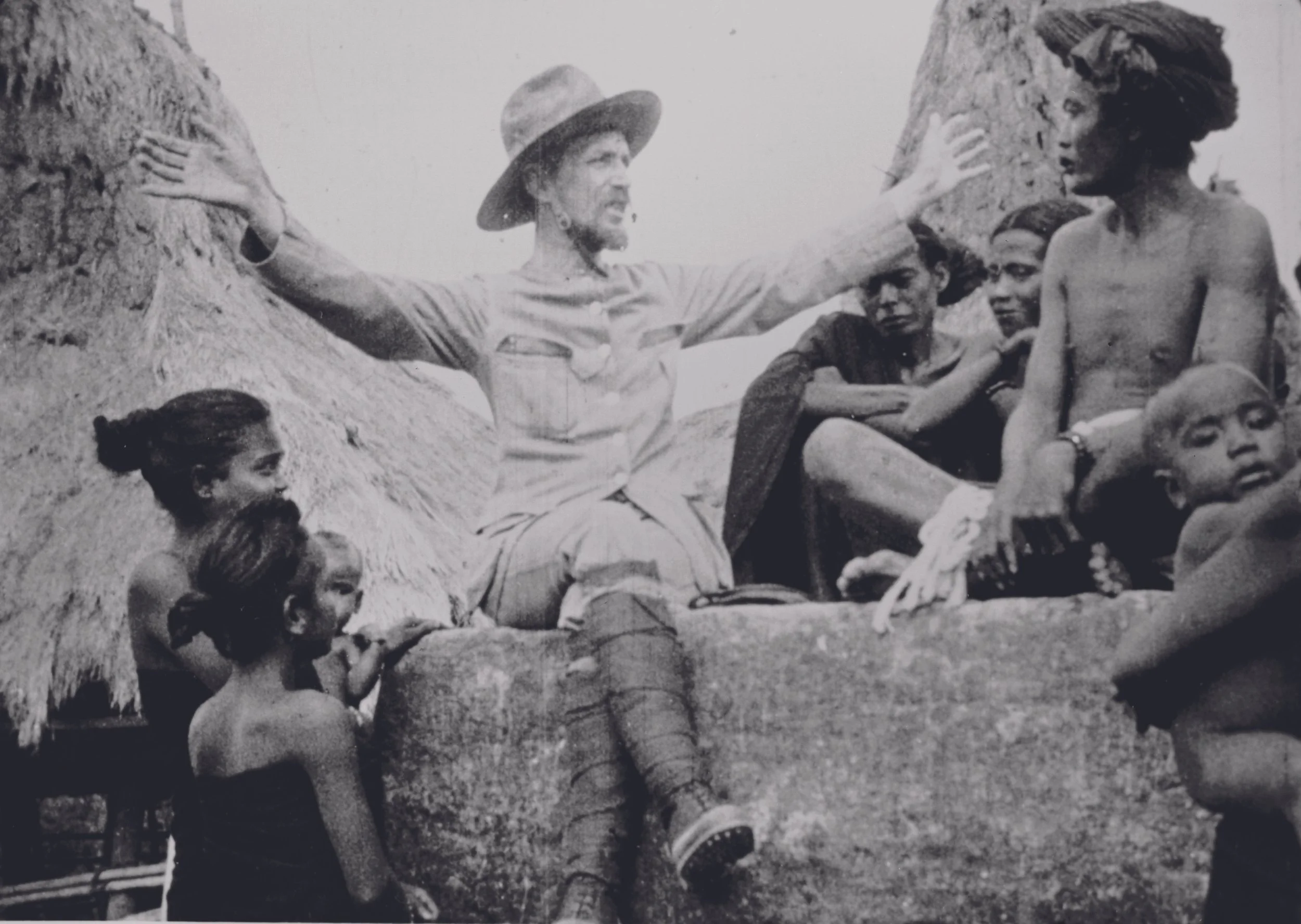
Colonial mansplaining in Mother Dao, the Turtlelike.
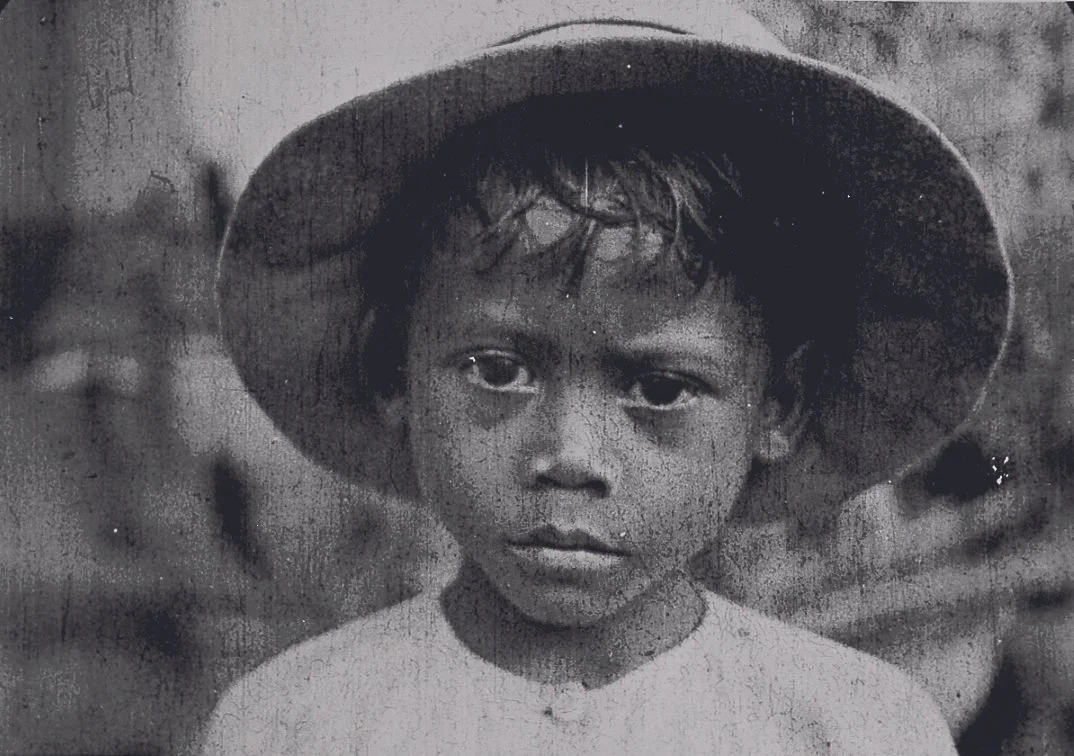
The weight of the world... - Mother Dao, the Turtlelike.
Vincent Monnikendam’s Mother Dao, the Turtlelike (1995) uses images taken in the Dutch East Indies (modern-day Indonesia) by propaganda filmmakers for the Dutch government, Christian missions, and plantation companies. The original intent behind the images was to justify imperialist intervention, glorify colonial “achievement,” and belittle the culture of the colonised. The visual expression of power imbalance in these films is through costume and architecture—the bright white armor of the colonists’ “uniform” and the intimidating scale of Western building projects, against the rags and hovels to which locals were condemned. The rapacity of the colonial regime is highlighted by exploitative and extractive schemes that depleted the indigenous economy and ravaged the landscape. The original material is not presented satirically—unlike, say, Santiago Álvarez’s ferocious polemic against U.S. racism in Now! (1965), shown in the same strand. Monnikendam enacts a formal and ideological opposition between oppressive image and liberatory soundtrack. The horror of what we see is counterpointed by music and the recitation of poetry and folktales, expressions of the collective voice and language erased from, or diminished in, official records.
Hothouse flowers - Stalin awaits his State Funeral.
Ideologically and artistically, Mother Dao could only have been made in the postmodern, postcolonial moment of the 1980s or 1990s. It is not difficult to imagine Sergei Loznitsa’s State Funeral (2019), however, being shown in 1953, in compulsory 24/7 screenings to commemorate the death of “General Secretary of the Communist Party of the Soviet Union” Joseph Stalin. After all, the entire film is made up of footage taken by state-sanctioned photographers. It seems to cover all aspects of the phenomena surrounding the death—its announcement throughout the far-flung republics of the Soviet Union; the official encomiums parlayed through loudspeakers as citizens go about their business; the conclaves of apparatchiks putting on official masks of grief while no doubt plotting behind the scenes; the awesome sight of numberless mourners traversing the country toward Moscow where Stalin lies in state; the arrival of foreign dignitaries at the airport; and the protracted funeral service and the body’s internment in Lenin’s mausoleum. Loznitsa manipulates his footage to imaginatively place the spectator in the Soviet Union in March 1953. It’s a terrifying and suffocating place to be.
The spectacle of death in State Funeral.
Like Monnikendam, Loznitsa contrasts his images with an invented soundtrack – a foley soundscape of crunching gravel, the mutter of conversation, the drone of state broadcasting. Whereas Mother Dao’s soundtrack is clearly differentiated from the film’s images, however, Loznitsa’s only increase the overpowering monotony and bombast of state protocol. There is too much, and it seems to go on forever. Everything—geographically, emotionally, intellectually, and historically—converges to one point, the corpse of a man who violently shaped the body politic of a nation throughout four decades. Loznitsa only acknowledges hindsight at the very end with intertitles outlining Stalin’s crimes. To the faceless crowds walking toward Stalin lying in state, desperately hoping that the cameras do not spot any slippage of their public grief, there is no hindsight. The funeral is simply another ritual of dehumanization, a further hollowing out of the public and private spheres. State Funeral is a mirror image of Loznitsa’s latest film, Two Prosecutors, both depicting complementary aspects of life under Stalin. [See interview with Loznitsa about his new film in the Summer 2026 issue of Cineaste.] The first is a documentary in which Stalin’s body is visible; the second is a fiction where Stalin is invisible but omnipresent. Both give form to intangible terror.
To qualify as a true found-footage film there probably should be a separation between the original filmmakers and participants and those reusing their images later (it is surprising that none of the texts in the All the World’s Memory catalogue provide a taxonomy of the found- footage film). Several of the new films in Thessaloniki recycled footage already shot by their directors and so may need a different designation. Nevertheless, even these films play on the genre’s dependence on time—the dialectical interplay between the period when the original films were shot and that of their new arrangement.
Abd Alkader Habak and Janay Boulos, directors and subjects of Birds of War.
Birds of War highlights clandestine footage of the Syrian Civil War taken by Abd Alkader Habak and forwarded to BBC Arabic correspondent Janay Boulos. As the title indicates, the virtual colleagues eventually fell in love and married, but the disjunction between the horrors shown in the archive footage and the tense peace of the present in London exile (a “peace” largely taken up with campaigning against Israeli actions in Palestine) means that “happily ever after” is not an option.
A group of Polish pals making horror movies in Candidates of Death.
One of the great surprises of the festival was the hilarious and moving Candidates of Death. For a period of fifteen years, Maciej Cuske documented his son and two friends shooting horror movies for an online platform. Candidates of Death has the cumulative impact of Richard Linklater’s Boyhood (2014) and the British 7 Up television documentary series as we watch the boys grow up, navigating young adulthood, but gives a greater agency to the participants. In a festival overstuffed with grim tidings, this was film to quicken the heart (to quote the best loved of found-footage films).
Perhaps the one true ‘found footage’ film among the new productions was Juliette Binoche’s In-I In Motion. It was funny to see how the documentary festival earnestness of the participants quickly evaporated when an Undisputed Film Legend came to town. Tickets to the screening attended by Binoche and a later masterclass were so hard to come by that the atmosphere was more Charlie and the Chocolate Factory than Workers Leaving the Factory (the Harun Farocki film shown in the All the World’s Memory strand). All pretense at critical distance went out the window during the post-screening Q&A as we lapped up every charmingly delivered truism about “creativity” and “self-discovery” as if it were philosophical gold.
Body alignments - Juliette Binoche and Akram Khan in In-I In Motion.
When successful actors turn to direction, they are often so desperate to prove that they are not as shallow as the films they appear in, they turn to deliberately dark or challenging subject matter. In the past year, for example, Kristen Stewart and Harris Dickinson have directed (and won critical acclaim for) stories about abuse, mental health, violence, and suicide. With delightful Gallic insouciance, Binoche bucked the miserabilist trend by making a film entirely about…herself!
In-I In Motion comprises outtakes of footage shot by her sister Marion Stalens of Binoche’s collaboration with dancer Akram Khan in 2008. Before you dismiss such a project as monstrous vanity, imagine if we had a film made by Greta Garbo or Charlie Chaplin reflecting on their own work by analyzing its creation via the repetition of rehearsal and production (Kevin Brownlow and David Gill attempted such a thing with outtakes from City Lights in their 1983 documentary series Unknown Chaplin). A reflection in images rather than inadequate words. In-I In Motion is, quite simply, a sustained reflection by one of the great performers on her work, her persona, herself. The first half documents Binoche and Khan rehearsing, accommodating their respective bodies and disciplines to each other over a prolonged period; the second, a kind of artistic “QED” of the problems posed in the first, presents the performance itself. Binoche synthesizes two discrete forms (acting and dancing) via a third, the cinema. This is editing as thought and interpretation, resulting in a true essay film—the French word essai can mean a textual essay, as well as a kind of testing or experimentation. If Binoche wants to make a follow-up film about brushing her teeth or walking the dog, she will have a ready and adoring audience.
Documentary noir - the festival's top prizewinner, Closure.
Plumbing the depths in Closure.
As if to confirm Psychoulis’s perception that archive fever has been replaced by archive fatigue, the festival’s top international competition prize was won by Closure, a film that forgoes found, appropriated, or archival footage. Michał Marczak shoots his subject in the manner of a European crime thriller—so much so that introducing it in Thessaloniki, he had to assure viewers that the film was a documentary and not a staged fiction or docudrama. The only “second-hand” footage is from a surveillance camera that refuses to yield meaning, to be interpreted or appropriated. Like Antonioni’s Blow-Up, Marczak uses both the documentary and detective genre to mount a critique on “archive imagery,” and its promise to provide access to the past.
It follows Daniel Dymiński as he haunts the river Vistula in rural Poland in search of his missing son, last seen on a bridge before disappearing into a CCTV blind spot. The nocturnal compositions of the cinematography may evoke genre films by the likes of Jean-Pierre Melville or Dominik Moll, but the eerie and seemingly endless images of Daniel gliding up and down the river, searching for yet dreading to find the washed up corpse of his son, seem closer to the last episode of Rossellini’s Paisa (1945), with its rafts and resistants in the Po Delta, or something mythic and metaphysical like Coleridge’s Rime of the Ancient Mariner. Ultimately, the film is less a mystery or quest narrative than a character study of a man, successful and powerful in life, trying and failing to control an unfathomable reality. What do you call a documentary that has nothing to document?
Darragh O’Donoghue is an archivist at Tate Britain in London.
For more information on the Thessaloniki Film Festival, visit here.
Copyright © 2026 by Cineaste, Inc.
Cineaste, Vol. LI, No. 3
Quisque iaculis facilisis lacinia. Mauris euismod pellentesque tellus sit amet mollis.