
Love in the Suspended Time of COVID: An Interview with Olivier Assayas (Web Exclusive)
by Mitchell Abidor
Two films were released in the summer of 2025 that expressed the extremes of the COVID pandemic. There was Ari Aster’s Eddington, with its account of the fury and madness that consumed so much of America and the world. The New Mexico town of the film’s title spends the film tearing at itself, its citizens holding daggers drawn against each other, against the government, against anything and everything, until a pandemic-induced apocalypse occurs. The madness of Eddington was not just American, though its depiction in Aster’s film is very specifically so. Other countries experienced the same syndrome, France no less than others. France was, after all, the country that produced the conspiracist documentary Hold-Up (2020), a critique of the government’s management of the Corona Virus, which garnered millions upon millions of views. But, as if in response to Eddington, this summer there was also Olivier Assayas’ Suspended Time, which was an expression of another COVID, the one of those able to withdraw from the world, to cultivate their own gardens, to live a different, slower, more profound life than the one they’d lived before the lockdown. Suspended Time is the anti-Eddington, a film about those who had a good lockdown.
Assayas’ film is openly autobiographical, at points whimsically so. The film was shot in Assayas’ family’s country residence, where he spent his time during the lockdown. The two male leads, Paul and Etienne Berger are, respectively, a filmmaker, played by Vincent Macaigne, and a rock critic, played by Micha Lescot, as are Assayas and his brother. Though their family name in the film is Berger, at one point Paul’s narration in voice-over discusses his grandfather, who is named Assayas. The casting confirms the film’s autobiographical nature, the role of the filmmaker Paul played by Vincent Macaigne, who has appeared in several of Assayas’ films, always as a neurotic stand-in for the filmmaker, as in the TV series Irma Vep (2022).
Suspended Time is thus a kind of autofiction as well as a work of historical fiction. History, in the form of the pandemic, is both omnipresent and absent, lurking off screen. As if these were normal times, favorite songs of the past are played and dissected by the brothers, the joy interrupted by the reminder that some of the singers whose music they admire, like John Prine, are now dead, precisely of the illness they are hiding from.
Paul is a maniac about obeying the measures imposed on the population, even insisting that boxes of food purchased from the supermarket—which they don’t dare visit—be left outside their house for four hours so the infectious matter can dissipate. Etienne is a tad more relaxed in his attitude, but that’s only on the surface. Both are subject to seemingly unrelated obsessions, which manifest their fear of the pandemic. Paul has purchased an expensive pot, which he accidentally ruins by overcooking strawberries. He spends much of the film scraping its bottom in a vain effort to save it. Etienne’s obsession is more productive. He is forever in the process of whipping up batches of crêpes. We seldom see anyone other than him eating them, but it’s his therapy and he sticks to it.
In this pandemic idyll, life as they knew it goes on as before, though at an easier pace. Paul continues to see his psychiatrist over WhatsApp and Etienne records his music show. But the brothers are not alone; they are accompanied by their lovers. This is the most important element of their retreat from the city. The time in the country house gives the brothers a chance to deepen their relationships with their girlfriends, Carole (Nora Hamzawi) and Morgane (Nine d’Urso). With none of the noise of Parisian life to distract them, Paul and Morgane and Etienne and Carole now have the time to explore each other, to find the rhythm so essential to the life of a couple. Etienne and Carole had been having an affair, but since Etienne has left his wife, he and Carole now have all the time in the world, not stolen nights. All of them, during this time of unimaginable death, are living and beginning new lives. Suspended Time is a film about a fulfilling and happy life that was made possible at a time of mass death.
Carole (Nora Hamzawi) and Etienne (Micha Lescot) finally have time together thanks to the pandemic.
We interviewed Olivier Assayas for Cineaste, in French, via Zoom; the translation is mine.—Mitchell Abidor
Cineaste: So much of what’s in the film is drawn directly from your life. The two brothers in the film are a filmmaker and a rock critic, like you and your brother, and stories are told that are drawn from their lives and those of family members. This is a really personal film about a world historical event.
Olivier Assayas: I wanted to make a film in which everything would be true, or as true as possible, so I tried to reconstruct the conversations I’d had with my brother, both the arguments and the warmest moments. I filmed in the house where I grew up. I evoked the memories I shared with my brother.
Cineaste: And Paul’s scraping at the pot and Etienne’s obsession with making crêpes?
Assayas: I thought it was interesting that my neuroses focused on the cleaning of the pot, and that my brother found it therapeutic to make crêpes. I found all this comical. It was all totally true, however absurd it was, and at the same time it was funny; it added an element of comedy.
Cineaste: The circumstances of the lockdown encouraged the development of manias.
Assayas: Yes. I think that everyone did his or her best in a frightening period, one that fed anxieties. The anxieties were internal, repressed, because the pandemic’s great length made it so you couldn’t live your anxieties all the time, for weeks and months. Even so, there were moments when they had to burst to the surface, had to emerge, to explode.
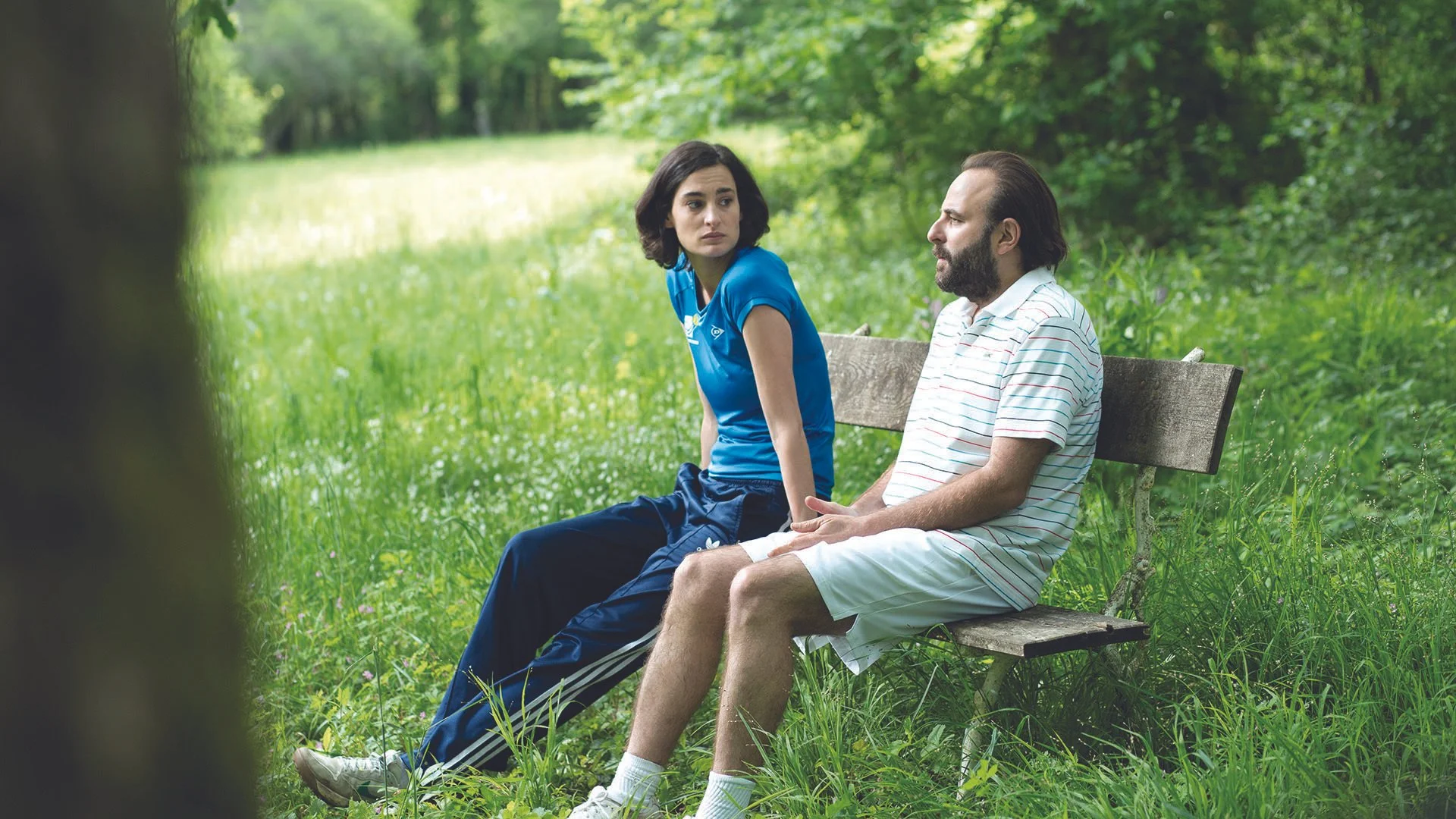
Morgane (Nine d'Urso) and Paul (Vincent Macaigne) discuss their future.
Cineaste: I noticed that for all the conversation among the four residents, there’s no discussion of the damage caused in the outside world, of the situation in hospitals, for example.
Assayas: Of course. In the house we were, by definition, cut off from the world. We were living through something totally unexpected. I recently read a book I’d never read before, Daniel Defoe’s Journal of the Plague Year, and I was struck by the extent to which epidemics produce the same effects across time, like the attempts to understand, to listen to farfetched or absurd ideas. We find ourselves in a situation we can’t control, in which we don’t have a user’s guide to what’s happening. It’s true that I always had the feeling that my experience was singular, that it was unique. I think everyone experienced the period in a different way, but some were lucky, were privileged. I was among them, since I had a family home, my father’s, where I could take refuge. I saw that it was better to be a refugee in the countryside, where I could go out, breathe, and so on. But, of course, I don’t think I was blind to the suffering of those less lucky than me. I was afraid, I constantly followed the mortality rate and I was horrified by the ways that here and there therapeutic choices were made that weren’t necessarily good ones. I found it was very difficult to find my true place, because in those circumstances the first instinct is to protect yourself, your family, your children, and to do your best in that regard. Some people lived this in the register of rage, violently hostile to mask-wearing, while others lived it in a more interiorized fashion, or with more anxiety. For my part, I lived it in a state of anxiety.
Cineaste: Have you seen Eddington?
Assayas: No, I haven’t seen it yet. It’s showing in Paris and I’m not there.
Cineaste: That is a typically American film, where everyone is in a constant state of rage. In the end, it all degenerates into what Philip Roth called in another context, “the American berserk.” Your film, on the other hand, is an elegiac film about a period of mass death.
Assayas: In a way, I had the feeling that beyond what made me anxious, what made me suffer, was that here was the opportunity to live through a historic moment. I haven’t lived through many historic events—I lived through May ’68 in France, a kind of revolution, when I was thirteen—and I lived through the lockdown. It was a significant collective experience, and every experience like that is a good one to learn from. I have the impression, now that COVID is behind us, that the experience of having lived through that event gave me something. And, like every experience, it was creative.
Paul Berger (Vincent Macaigne) leafs through a beloved book from his childhood.
Cineaste: There’s a moment when Paul refers to the time as a “parenthesis.” When did the parentheses close?
Assayas: That’s the question I asked myself at the time, while writing the film during COVID, but that I didn’t ask when I shot the film two years later. While shooting it, I didn’t touch the script and there were many things that resurfaced at that time that I’d forgotten, that came back to me. I think the parentheses closed at the end of the lockdown when I realized that nothing had changed. I’d felt the world had been enormously transformed, that it was a planetary event, abnormal. I told myself we weren’t going to return to the way things were before. It was going to open doors, we’d see it had had many effects, some good, some bad, but we’d be entering a new world. But then I realized that no, the epoch had closed and we no longer talked about it. We forgot, we swept it all under the rug. And when I thought of Journal of the Plague Year, where at the end everyone returns to London and from one day to the next it was over, and the world hadn’t changed. And COVID hadn’t changed the world.
Cineaste: It was French novelist Michel Houellebecq who said during the heart of COVID that everything would be the same, but worse.
Assayas: As is often the case, he demonstrated his lucidity.
Cineaste: What led you to decide to assign the actors to their respective partners. Why was Morgane [Nine d'Urso] with Paul [Vincent Macaigne], and why was Carole [Nora Hamzawi] with Etienne [Micha Lescot]? Couldn’t they just as well have been matched in the other way?
Assayas: When I was writing it, I was almost certain that the role of Carole would go to Nina. I thought of her all along. I had met here, as with Vincent Macaigne, during the making of Non-Fiction [2018], I wanted to work with her again when we made the Irma Vep TV series, because I admired her enormous capacities, her ability to improvise. I thought it better to give her a more serious role, that of a woman in love. As for the other female lead, played by Nine, I met her later, and our connection was strengthened during COVID. But your question is a good one, very perceptive, because it’s a question I asked myself before making the film.
Paul reads his way through his father's library during the lockdown.
Cineaste: Your admiration for Sacha Guitry is well known, and he even gets a mention in the film. Were you ever tempted to add Guitry-like elements to the relationships between the couples?
Assayas: No, but mainly that was because for me the film was constructed around two relationships in a gestational state during COVID. It wasn’t a comedy of couples or adultery. On the contrary, for me it was the birth of love. It was also the circumstances: I’m telling stories from the lives of my brother and myself. For me there was something important about the nature of beginnings. There was the idea that potentially, through the two couples, the two men, who were no longer exactly young, would find the feeling of a beginning, of reconstruction.
Cineaste: There’s a question an interviewer asks Paul that I’d like to ask you. What gives you hope?
Assayas: [Laughter] What gives me hope? Let’s say that at the time of the lockdown what gave me hope was the idea that we were going to wipe the slate clean. That we were going to start everything anew. That we had the right to say that my generation had failed, that we’d missed a turn in the road, and that we now had the chance to get back on the right path. And that perhaps there was the possibility of making something good out of something evil. It’s not what happened. If I had to answer that question today, then honestly, few things give me hope. I don’t want to be as gloomy as the character in the film, but I have to say that recent political events in Europe and the United States are particularly frightening, things that I never imagined I’d live through.
Morgane and Paul enjoy a romantic moment in Paul's family's garden.
Cineaste: Did you miss shooting a film during those years?
Assayas: No, because in fact I never stopped. During lockdown, I wrote the script for Irma Vep series, which was quite an ambitious undertaking. I wrote it quickly and quickly moved on to shooting it when the lockdown wasn’t yet lifted. We shot it wearing masks, being tested three times a week. After Irma Vep I made Suspended Time, and now I’m in the process of finishing up The Wizard of the Kremlin.
Cineaste: In the film Paul is reading A History of Sex Crimes. Did Vincent Macaigne choose it?
Assayas: No, it was me. I found it in my father’s library.
Suspended Time is distributed in the United States by Music Box Films.
Copyright © 2025 by Cineaste, Inc.
Cineaste, Vol. LI, No. 1
Quisque iaculis facilisis lacinia. Mauris euismod pellentesque tellus sit amet mollis.