The 50th Polish Film Festival in Gdynia (Web Exclusive)
by Darragh O’Donoghue
2024 marked one hundred years since the death of Franz Kafka, one of the most influential figures in world literature. Agnieszka Holland’s Franz screened at the 50th Gdynia Film Festival a year too late. Kafka might have appreciated the inadvertent gesture—he is the author laureate of the belated, of failure, or doomed plans, and of paralyzed organizations. Holland herself is no stranger to belated recognition. Her last film Green Border (see interview with Holland about the film in Cineaste, Fall 2024)—a ferocious critique of the Polish government’s hostile refugee policy—was banned from the 2023 festival. It was eventually screened in the 2024 edition—months after liberal Donald Tusk beat the far-right incumbents—and predictably won the grand prize, the Golden Lion.
Franz had premiered at the Toronto International Film Festival a fortnight earlier, where it had a muted reception, despite being in some ways a more ambitious and original film than Green Border. Holland could easily have gone down the tried and trusted cinematic route of presenting Kafka, a route charted by the likes of Orson Welles, Steven Soderbergh, Harold Pinter, Michael Haneke, and the Quay brothers. In other words, a tense account of a physically and spiritually weak man embattled by hostile others and his environment. Such a route is generally monotonous—in the sense of employing one dominant tone, characterized by gloom, decay, fear, anxiety, and dark shadows.
Holland, who trained in Prague’s famous FAMU film academy, does not choose this route. She uses as her starting point the diverse heritage of her subject—this is a Polish film about a German-speaking Czech born into the Anglo-Hungarian empire. Rather than following her subject chronologically from cradle to grave like most biopics, she presents a Kafka rooted in yet transcending his time. Kafka’s story is interrupted by flashforwards that extend beyond his lifetime, revealing the fate of his sisters in the Holocaust, for instance, or exploring his legacy as an unlikely tourist attraction.
The film’s approach is much closer to the work of an early admirer of Kafka, rather than Kafka himself—the German playwright Bertolt Brecht. Franz is a form of epic theater, comprising a series of self-contained “bits” or “skits”—recreations of famous scenes from Kafka’s life; adaptations of key moments from his work; parodies and pastiche; documentary footage; abstract footage more typical of artist filmmaking; theatrical; passages of direct address.
Further, despite a title named after a singular author and the attendant expectations of the biopic genre, Franz does not present Kafka as a consistent, psychologically plausible, historical actor. Instead, Holland offers a range of different, often contradictory or inconsistent Kafkas. There is Kafka the athlete, lover, and joker. Kafka the insurance man. The Jewish Kafka. Kafka the insomniac writer at his desk. Kafka the family man and homosocial friend. Kafka the theatre-goer. Kafka the patient and hypochondriac. Kafka the bully, the paranoiac, the fantasist, the conformist, the rebel. Kafka the city dweller ill at ease in the countryside. Kafka the technology geek.
I have always admired Holland’s films more than I have enjoyed them, but Franz is astonishing, the work of an artist able to bring decades of experience in different media and production contexts to bear on a great synthesizing work. Of course, the whole thing rests on Idan Weiss’s remarkable Best Actor-winning performance, as physically and emotionally versatile as the Yiddish actors and silent clowns Kafka so admired. Franz was by far the best new film I saw at Gdynia, though it was beaten to the grand prize by Piotr Domalewski’s Altar Boys.
Idan Weiss as Franz Kafka.
Such was the overwhelming force of Franz, which I saw on my first day at the festival, that it colored everything else. It was impossible not to see the “Kafkaesque” in other films, no matter how mediocre or modest the work. Both the student short The Croak and the vampire romance Life for Beginners explore body horror and the borderline between human and animal, consciousness and matter, that are central to Kafka texts like The Metamorphosis. Perhaps because its brevity matches that of Kafka’s fables, The Croak is more successful as director Xymena Zaręba explores the Gregor Samsa-like transformation of a youth into a frog and its effect on the family home dominated by a problematic father. Life for Beginners is set in a retirement home where vampire Monia (Magdalena Maścianica) works as a night nurse to access amply available blood. Paweł Podolski’s film becomes a feel-good Rom-Com replete with age- and body-positivity and cathartic pagan dancing, but its early scenes evoking Monia’s solitude and feelings of abjection might be classified as YA Kafka.
Life for Beginners: Comfort break
In Nothing Else, another student short, a perfect young couple have their perfect life in their perfect modern house shattered when the wife is diagnosed with a terminal illness. What gives Jakub Prysak’s film a Kafkaesque frisson is not the illness itself— with blood and guts deliberately airbrushed from the lifestyle magazine images—but a plotline that sees objects inexplicably disappear from the house. The perfect home, a bubble of comfort and safety in a complex world, becomes uncanny and under threat.
Kafka was forty when he died in a sanatorium; the Polish Film School legend Andrzej Munk was weeks from his fortieth birthday when he was killed in a car crash. Like Kafka’s relatives, Munk and his Jewish family underwent the Nazi occupation of Eastern Europe. Unable to escape Poland, Munk hid in Warsaw and participated in the 1944 uprising. The failure of that resistance was commemorated in Kanal (1957) by Munk’s namesake Andrzej Wajda, a filmmaker often labeled the quintessential Polish Romantic filmmaker. Wajda’s Romanticism—emphasizing national identity, the landscape, fate, and history—has often been contrasted with the works of Munk, grounded in a realism shot through with irony and black humor, presenting stories of little, sometimes Jewish men caught up in absurd systems and ideologies, like Man on the Tracks (1956) Bad Luck (1960), and the ironically titled Eroica (1958). Such a dialectic does a disservice to both filmmakers, but it is true that even in his lifetime, Munk’s works were compared to Kafka, a comparison strengthened by Munk’s mastery of the short form (Munk began his career working on the Polish Film Chronicle newsreel; Eroica is made up of two short stories), while his most celebrated film, The Passenger (1963), was unfinished at the time of his death, like several works by Kafka. The power of this Holocaust drama lies in its absence of rhetoric and its cool analysis of power dynamics and moral compromise at the extremes of inhumanity—it breathes a similar spirit of deadpan horror as Kafka’s story “In the Penal Colony.” Unfortunately, Michał Bielawski’s bog-standard clips-and-talking-heads documentary The Passenger Andrzej Munk is unworthy of its mercurial subject. At best it will serve as a supplement on a future Criterion edition of Munk’s films, although its primary address to a local audience means that a lot of the political and cultural context of the life is taken for granted and may baffle outsiders.
Most of the new films I saw at Gdynia this year were sub-par and included a 1980s-style erotic thriller (Three Loves) and an amiable sequel to an amiable popular heist movie (Juliusz Machulski’s Vinci 2). For some reason the other great Polish film of 2025—Wilhelm and Anka Sasnal’s The Assistant, an adaptation of Kafka’s Swiss contemporary Robert Walser that matches Franz in its willingness to experiment with literary adaptation and period reconstruction—did not screen at Gdynia; I saw it at the London Film Festival a month later. Luckily, there were more stimulating pleasures in the festival’s various retrospective strands. Some of the classics shown will be familiar to Cineaste readers, such as Wajda’s Ashes and Diamonds (1958), Kieslowski’s A Short Film About Killing (1988), and the films in a mini-Jerzy Skolimowski retrospective.

Hospital of the Transfiguration: Petty squabbles on the eve of disaster
Hospital of the Transfiguration: Do no harm
Two lesser-known films are downbeat masterpieces of confinement and occupation, shown as part of a lifetime achievement tribute to production designer Ewa Braun, who won an Oscar for her work on Schindler’s List. Hospital of the Transfiguration (1978) is based on a novel by Stanisław Lem, a Polish follower of Kafka’s, while An Uneventful Story (1982) adapts a story by Chekhov, one of his precursors as a master of the short form and as a premature victim of TB. Hospital of the Transfiguration is set in a psychiatric institution where Dr. Stefan (Piotr Dejmek) is the newest member of staff. The oppressive rhythms of medical routine and patient control take place in a timeless environment of antiseptic white rooms. This isolation is revealed to be more like a quarantine and is brutally interrupted by history in the form of Nazi occupiers, leading to a haunting finale that transmutes traumatic fact into traumatized fantasy. The entire atmosphere—in particular the unsettlingly comic scenes at the staff dinner table as doctors jockey for power—was clearly influenced by Kafka.
An Unventful Story: They look but do not see
Uneventful Story
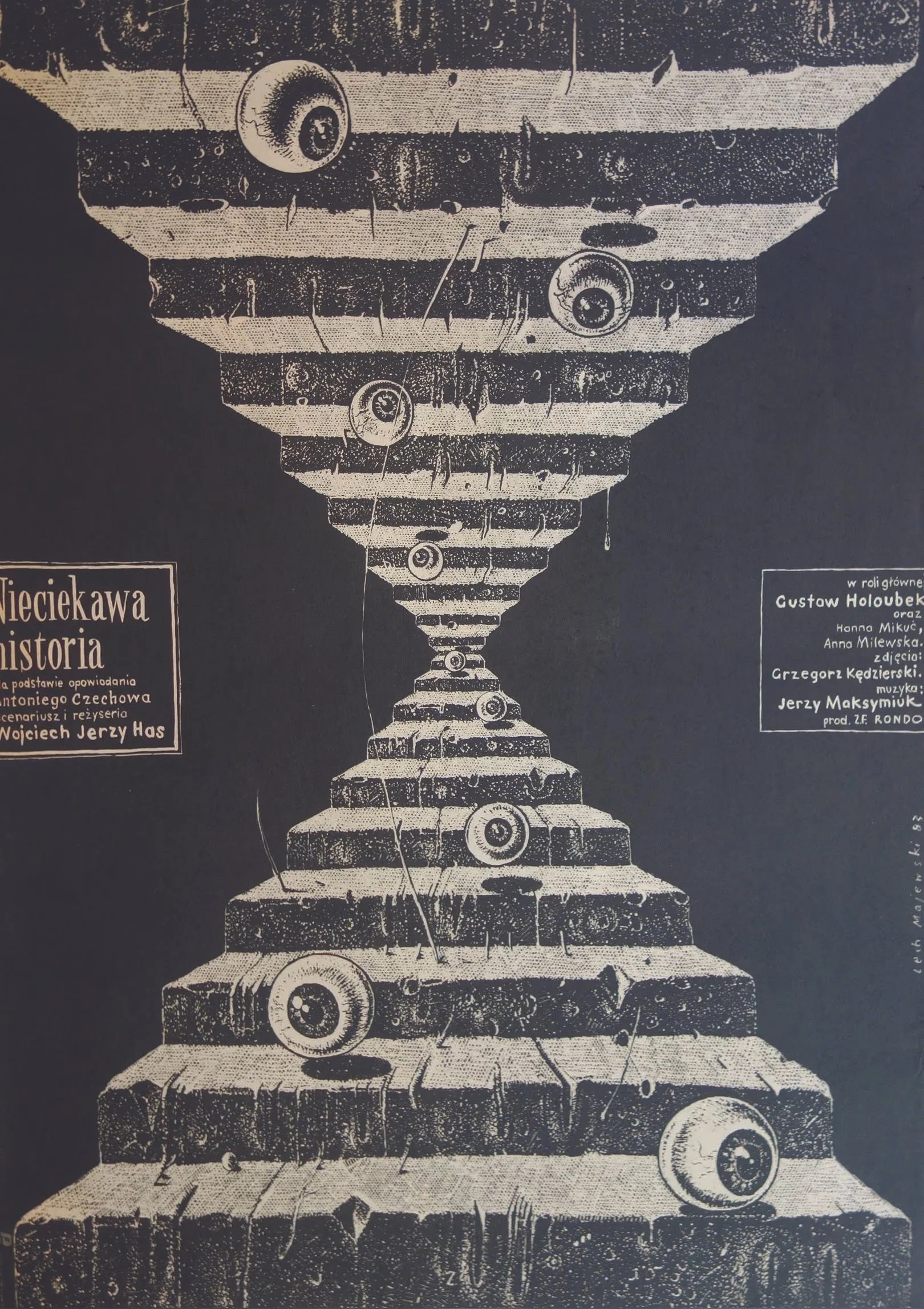
An Uneventful Story continues the medical theme and is even more subtle in its embodiment of power’s soul-destroying effects. The film screened as part of the “Year of Wojciech Jerzy Has” decreed by the Polish senate; an exhibition of imaginary posters for his usually fantastical literary adaptations was held at the nearby city museum. I must confess that I have always found Has’s most famous films disappointing—the quasi-Surrealist The Saragossa Manuscript (1965), admired by Buñuel, and the Bruno Schultz adaptation The Hourglass Sanatorium (1973), are to these eyes leaden and overliteral. With An Uneventful Story, however, leadenness is the point. The nonstory of an eminent, aging doctor who parses his life into discrete categories—home, work, adultery—as if he were isolating the symptoms of a disease, Has’s film was made during the period of martial law declared in December 1981 in response to the popular Solidarity labor movement. Has depicts an inert patriarchy subsisting in a kind of frozen suspension, where movements and social roles are severely circumscribed. The roving camera is constantly blocked by obstacles as if attempting to break through the spiritual impasse. It equals Kieślowski’s later No End (1985) as a memorial to this claustrophobic period.
When all is said and done, however, the Kafkaesque strain identified in this communiqué is a minor feature of a Polish cinema that clings to the nineteenth-century Romantic spirit. This spirit can be reactionary (as it often was during the Law and Justice regime of 2015–23), or iconoclastic. One film that was typical for local audiences but bizarrely exotic for visitors was Operation Pope. Based on the proverbial “true story,” Władysław Pasikowski’s thriller follows a dying ex-spy hired to foil the Kremlin-approved assassination of Polish pontiff John Paul II in 1981. Konstanty Bruno Brusicki is played by Bogusław Linda, an actor best known to Western cinephiles as the hero of Kieślowski’s genuinely Kafkaesque and suppressed Blind Chance (1981) and Dekalog 7 (1988). What is less well-known outside Poland is that Linda subsequently became a local superstar playing hard-boiled action heroes and revengers in the Charles Bronson or Mel Gibson mold, knocking down the corrupt and vacillating who get in his way. Operation Pope is no different, and there were roars of anticipatory laughter at the screening I attended during a sequence wherein Brusicki decapitates a dodgy local official. The cancer-ridden and spiritually depleted Brusicki is a walking corpse; the repeated attacks on his body might make him prime Kafka material, but here the brutalization only makes him, his mission, and his nation stronger. Brusicki would squash Gregor Samsa without hesitation. Operation Pope is terrible but performed by Linda and directed by Władysław Pasikowski with such conviction that this viewer at least was mesmerized. Sometimes, I’m afraid, cinematic pleasure is the sight of hard men putting the world to rights.
Bogusław Linda means business in Operation Pope.
For more information on the Gdynia Film Festival, visit here.
Darragh O’Donoghue, an archivist at Tate Britain in London, is a Cineaste Contributing Writer.
Copyright © 2025 by Cineaste, Inc.
Cineaste, Vol. LI, No. 1
Quisque iaculis facilisis lacinia. Mauris euismod pellentesque tellus sit amet mollis.