
The Big Heat (Web Exclusive)
Reviewed by David Sterritt
Produced by Robert Arthur; directed by Fritz Lang; screenplay by Sydney Boehm, based on The Saturday Evening Post serial by William P. McGivern; cinematography by Charles Lang; art direction by Robert Peterson; edited by Charles Nelson; starring Glenn Ford, Gloria Grahame, Jocelyn Brando, Alexander Scourby, Lee Marvin, Jeanette Nolan, Peter Whitney, Willis Bouchey, Robert Burton, Adam Williams, Howard Wendell, Chris Alcaide, Michael Granger, Dorothy Green, Carolyn Jones, and Edith Evanson. 4K UHD + Blu-ray or Blu-ray, B&W, 89 min., 1953. A Criterion Collection release.
Unlike many classic noirs and gangster films of the studio era, Fritz Lang’s 1953 masterpiece The Big Heat treats women both seriously and sympathetically. In one exemplary scene, singled out by Farran Smith Nehme in a video essay for The Criterion Collection’s new edition of the picture, the sadistic crook Vince Stone (Lee Marvin) brutally snuffs a cigar on the hand of a B-girl in a saloon, and his shocked girlfriend Debby (Gloria Grahame) leaps up to help instantly and instinctively, pulling Stone away so the victim can scramble to a nearby table. The event happens so quickly it hardly registers on the screen, but it speaks eloquently about Debby’s personality—she suffers greatly in the story without losing her spirit in the end—and about the movie’s refusal of the femme-fatale and spider-woman stereotypes built into the conventions of noir. In another Criterion extra, filmmaker Michael Mann connects the assertive women of The Big Heat with the prominence of women in the work force when men were away fighting in the recently concluded war. And in the audio commentary, the noir authorities Alain Silver and James Ursini suggest that women do much of the real work in the film, taking action and providing information that hero Dave Bannion (Glenn Ford) needs to resolve the investigation that drives the narrative.
When his police-department superiors refuse to act, Dave Bannion (Glenn Ford) embarks on a personal crusade for justice and revenge.
The plot isn’t labyrinthine, but a lot happens in The Big Heat, so here’s a quick recap. Lang establishes its dark tone in the opening shot, when a man named Tom Duncan kills himself with a bullet to the brain; we never see his face, and the Production Code stopped Lang from showing the gun at his head when it fires. A moment later Tom’s wife, Bertha (Jeanette Nolan), reads a letter he just wrote and notifies not the police, even though her freshly dead husband was a cop, but criminal boss Mike Lagana (Alexander Scourby), who’d very much like to get his hands on the document, which she promptly places in a safe-deposit box where prying eyes will never find it, evidently intending to blackmail anyone the document might name. Police sergeant Bannion gets the case, talks with the widow, and accepts her explanation that Tom’s suicide resulted from depression and worries about his health. Then he hears from Tom’s former mistress, Lucy Chapman (Dorothy Green), who says that far from being unhealthy or depressed, Tom was about to blow the whistle on a web of corruption in the police force and city politics.
Police officer Dave Bannion (Glenn Ford) fields a threatening phone call that will bear disastrous consequences for his wife, Katie (Jocelyn Brando), soon afterward.
Unsure how to proceed, Bannion takes a breather with his affectionate wife, Katie (Jocelyn Brando), in their modest suburban home. But word arrives that Lucy has been savagely murdered, and although Bannion’s superior, Lt. Ted Wilks (Willis Bouchey), wants to let things lie, a bartender tells Bannion that Lucy was talking too much for her own safety. Guessing that Lagana is behind the malevolence, Bannion confronts him in his mansion, but the lieutenant then orders him to back off his investigations. Increasingly troubled and pondering his options, Bannion is back home when an anonymous thug calls up, unloading a vicious threat on him and his family. They try to shrug it off, but soon thereafter Katie heads for the family car to pick up a babysitter, and while Dave amuses their little girl with a fairy tale, a bomb explodes in the driveway, killing Katie in a cataclysm clearly intended for her husband. More frustrated than ever when his superiors refuse to act, Dave throws down his badge and begins a personal crusade to bring the evildoers down, becoming a rogue cop who develops some resemblance to the villains he’s combating, as Martin Scorsese notes in a Criterion extra. Not that he’s anywhere near Stone’s horrifying league. In one of the film’s most famous turning points, Stone throws a pot of boiling coffee into Debby’s face, scalding and scarring her; in another, she gutsily retaliates. The big heat of this film is as macro as the pressure needed to eliminate civic crime and corruption, and as micro as the pots of scorching liquid that permanently damage two victims.
The Big Heat begins with the sudden suicide of police officer Tom Duncan, whose widow will be an important player in the story to come.
Telephones play prominent roles in many a film noir, and The Big Heat is bookended by them: Bertha calls up Lagana at the beginning, and at the end Bannion is back at his police-department desk fielding a call about a fresh homicide to investigate, signaling that although his private war is over the cycle of death, disorder, and corruption continues to spin. This points to what might be the most important of all the themes Lang explored over the decades of his career: the inescapable nature of fate and the inevitability of destiny, which supplied the English-language title of his 1921 classic Destiny, also known as Der müde Tod or The Weary Death. In line with this idea, novelist Jonathan Lethem gives the title “Fate’s Network” to his Criterion program essay, and Silver and Ursini say in their audio commentary that it was Lang who added the brooding fatalism to Sydney Boehm’s script for The Big Heat. They add that the film has hints of Jansenism, the Christian doctrine emphasizing the role of predestination in matters concerning salvation and redemption of the soul, and it’s indeed plausible to see the film’s cruelest events—the bombing that kills Katie, the disfigurement of both Debby and Stone—not as mere happenstance but as manifestations of some unknowable design imposed by forces outside any individual’s control. Subtle religious allusions are threaded through The Big Heat, where Lt. Wilks is washing his hands à la Pontius Pilate the first time we see him, Bertha disdainfully mentions her late husband’s “soul struggling,” and the pointedly ironic name of a gangster saloon is The Retreat.
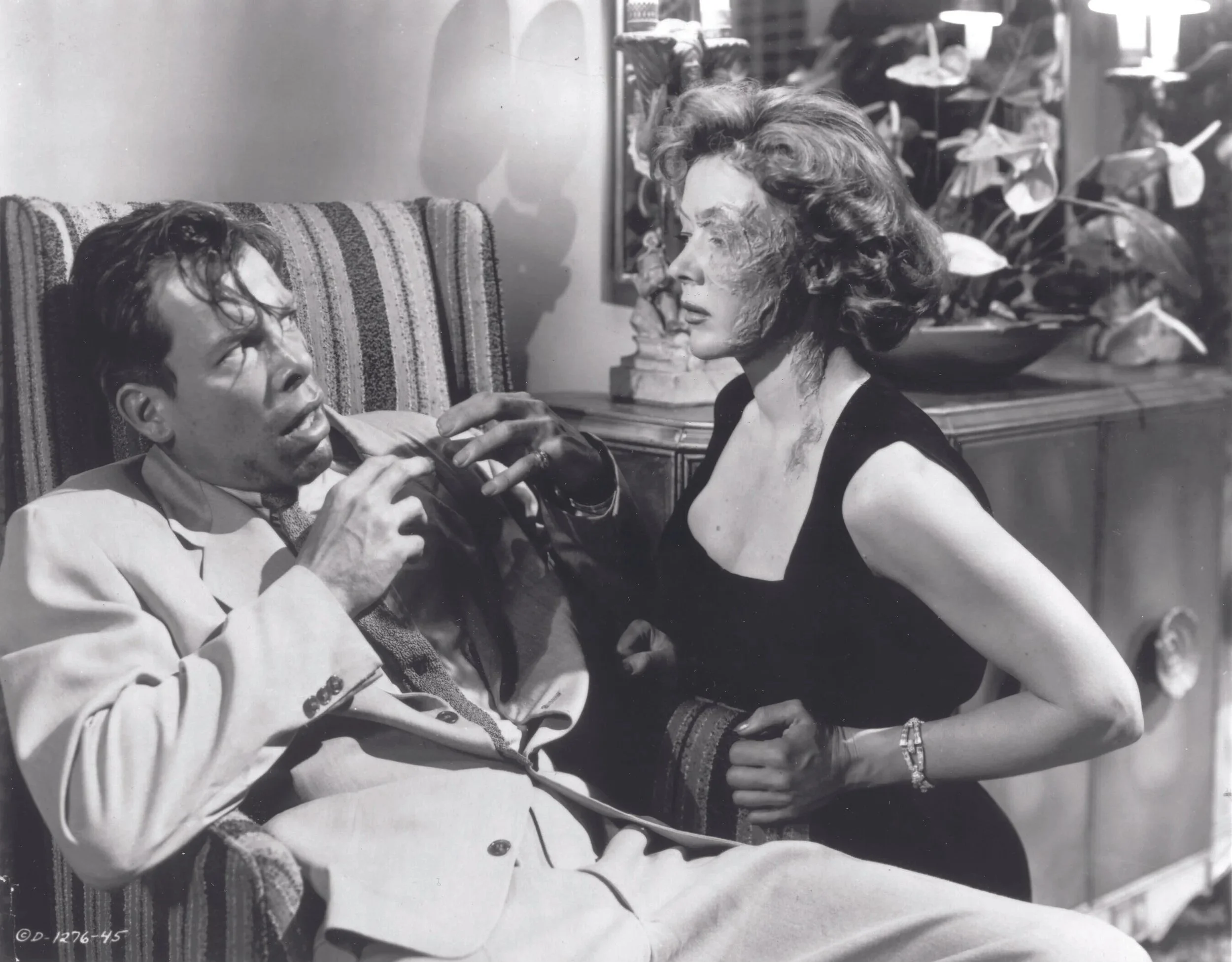
The villainous Vince Stone (Lee Marvin) is confronted by the tough-minded Debby Marsh (Gloria Grahame), whose face he scarred in a brutal earlier scene. Photo by Photofest.
On a more worldly plane, Silver and Ursini also stress Lang’s recurrent motif of discord between contrasting social spheres, with decency on one side and wickedness on the other. Noir often probes that kind of overarching conflict, which helps explain all the telephones in The Big Heat and likeminded films, since phones allow discrepant worlds to intersect and clash. When an unheeded telephone threat leads to Katie’s death and Bannion’s immersion in revengeful rage, the telephonic world of disembodied voices collides with the physical world of danger and violence, and the perils rapidly multiply. The film is defined by fateful entanglements, and as Lang says in a Criterion audio extra, the fact of the struggle is more important than its outcome. And it’s worth repeating that women are among the most intrepid fighters—hence the braveness of Debby; the courage of Selma (Edith Evanson), a working-class secretary who risks her safety to help Bannion gather evidence; and even the grim boldness of the widowed Bertha, whom Nehme likens to Lady Macbeth (an apt reference, since Nolan played that scheming character in Orson Welles’s 1948 adaptation of the Shakespeare play).
Various aspects of The Big Heat were affected by Production Code worries about violence; its studio, Columbia Pictures, was then under scrutiny along that line, and in England the film received an adults-only rating. But its style comes straight from Lang, a chief architect of Hollywood noir, and its visuals are realized to perfection by cinematographer Charles Lang, a versatile professional who gets the tone precisely right even though he doesn’t have much other noir in his filmography. By this time Lang was long past his German Expressionist origins and was favoring a relatively uninflected, “objective” look, as Scorsese says on the Criterion disc. Mann has a different opinion, saying the film’s deep-focus framing and chiaroscuro lighting show Welles’s influence at work, and Silver and Ursini concur in part, accurately noting that the picture takes on a shadowy expressionism when Debby seeks shelter with Bannion after Stone mutilates her face. My eyes align with Scorsese’s view, and I agree with the argument Tom Gunning makes in his definitive book The Films of Fritz Lang: Allegories of Vision and Modernity, where he writes that Lang’s style in the Fifties “began to resemble camouflage” as the movies “strive to resemble the very environment they critique.” Exactly. Lang’s objectivity is objectivity with a vengeance.
In a saloon ironically called The Retreat, sadistic criminal Vince Stone (Lee Marvin) faces off with upright cop Dave Bannion (Glenn Ford) as Stone’s girlfriend Debby Marsh (Gloria Grahame) looks on.
The Big Heat originated as a 1952 Saturday Evening Post serial (published as an intelligent and articulate novel in 1953) by William P. McGivern, a former reporter on the police beat in Philadelphia, where he learned of the real events—the suicide, the suicide note, the corruption it detailed, and so on—that inspired his plot. In an afterword to the novel published in 1982, McGivern casts interesting light on a wonderful interlude just before the movie’s ending. Lang didn’t want the story to conclude with a conventional movie shoot-out, McGivern says, but Columbia chief Harry Cohn insisted that a crime picture had to finish with a crash-bang climax. The director resolved his dilemma in an ingenious way: Bannion races after Stone, both with guns in hand, but comes upon Debby, shot by Stone and dying on the floor, and falls to his knees beside her, playing “a very tender and human scene” before resuming the chase, getting the drop on Stone, and handing him to the cops who arrive just in time to haul him away. “Within the shoot-out,” McGivern writes, “there is a pause, an emotional cri de coeur, the Lang touch that is remembered.” That gets to the essence of the touching moment, which isn’t entirely plausible—there is a shoot-out going on here!—but lends real poignancy to what might otherwise be a by-the-numbers noir finale.
Gunning calls The Big Heat one of the crowning films of Lang’s career, and any number of critics have given similar praise. Criterion’s new release captures all the nuances of its looks and sounds, and every extra is a welcome bonus. For me this is Lang’s most psychologically intense noir, replete with powerful close-ups, terse and rigorous editing, and economical, no-nonsense acting, all serving to evoke the chronic paranoia that’s so essential to Lang’s cinema and to postwar American culture writ large. “I guess a scar isn’t so bad,” Debby says with the unquenchable pluck that defines her character, “not if it’s only on one side. I can always go through life sideways.” She meets a tragic end before she can put that proposition to the test, but Lang’s finest movies do the opposite, meeting life with uncompromising, head-on vigor. The Big Heat stands with the best of them.
David Sterritt, a Cineaste Contributing Writer, is author or editor of seventeen books on film.
Copyright © 2025 by Cineaste, Inc.
Cineaste, Vol. LI, No. 1
Quisque iaculis facilisis lacinia. Mauris euismod pellentesque tellus sit amet mollis.