
The Postapocalyptic Dystopian World of 40 Acres: An Interview with R. T. Thorne (Web Exclusive)
by Paul Risker
Canadian-born director R. T. Thorne’s directorial feature debut 40 Acres opens on an armed militia approaching a farmhouse. A violent shoot-out ensues as the invaders attempt to take the forty acres of farmland by any means necessary from the Freeman family, led by Hailey (Danielle Deadwyler), a former soldier, and her indigenous partner Galen (Michael Greyeyes). Successfully repelling the attack, Hailey and Galen know future incursions onto their land are inevitable because, in this famine-stricken near future, farmland has become the most valuable resource.
It has been fourteen years since a fungal pandemic decimated eighty-nine percent of the animal biosphere. Two years later, the collapse of the global food chain triggered a second civil war that condemned the planet to an unforgiving famine. The recent past has been blighted by plague and war, turning the planet into a dystopian hell. Hailey has therefore turned the family’s isolated forty acres into a fortress. She and Galen designate responsibilities to their four children—Emanuel, referred to as “Manny” (Kataem O’Connor), Raine (Leenah Robinson), Danis (Jaeda LeBlanc), and Cookie (Haile Amare).
Manny is now coming of age, and his ideas and ideological outlook conflict with those of his mother, who cannot cast aside the traumatizing memories of war. Together with Galen, they escaped the societal collapse and have taught their children to live off the land and to fight to kill.
Prone to impulsive outbursts, Manny doesn’t give his responsibilities the attention his parents demand, and he even fails to be present at an indigenous coming-of-age ritual for one of his sisters. Familial bonds are vital to their survival, but Manny is straining the cohesion of the family unit and his mother worries about whether he’ll be ready to be the family’s patriarch when the time comes.
Unwilling to heed his mother’s warnings about the threat beyond their fences, Manny is seduced from afar by Dawn (Milcania Diaz-Rojas), a mysterious young woman he spies swimming in a creek one day when he’s off exploring beyond the confines of the forty-acre perimeter. When she turns up at their fence, panicked and pleading for help, he ignores the strict regimental rules and secretly provides Dawn sanctuary. At first, he keeps her tied up and gagged until he’s sure she’s not a threat. This is also to protect her from his family and their paranoid suspicion of strangers.
Unbeknownst to Manny, he has been lured him into a trap. He has begun a chain of events that will put his family in a perilous standoff with a manipulative militia. This is the same militia responsible for taking over several farmlands in a network that primarily communicate via ham radio.
40 Acres is an unsettling genre film that uses the premise of a dystopian future to explore family dynamics and generational tensions. The suspenseful action set pieces are thrilling but the scenes that make an impression are the emotional ones, especially those between Hailey and Manny. Deadwyler is excellent as the emotionally and psychologically wounded matriarch. Meanwhile, O’Connor plays a young man trying to understand the barren world and his isolated existence on his own terms. His hope and naiveté leave him emotionally and psychologically vulnerable.
Thorne’s film isn’t aggressively political, but a Black and indigenous family having to fight to defend themselves from the threat of being displaced or slaughtered will inevitably politicize it as a commentary on colonialism. The director attempts to construct 40 Acres as a Trojan horse, compartmentalizing its political commentary by placing it inside an entertaining genre film. Thorne attentively balances the different tones, pivoting between laughter, hope, and warmth, and the darker tones that compel fear, cynicism, and despair.
While the triggered and fearful matriarch echoes the paranoia of 1970s cinema, 40 Acre’s depiction of a future society is a timely reflection on perennial sociopolitical divisions and conflicts and the price we may have to pay for the mistakes of the past and our present day. After all, Thorne is sharing a vision of how civilized order hangs by a thread, which, when cut, will spiral into an amoral and primitive void.
In a recent conversation, Thorne reflected on being content taking his time to express himself in the feature-film format, how a film is an evolving conversation, and how Seventies and Nineties cinema have made a lasting impression on him. He also discussed the difficulty of escaping political messaging as a Black filmmaker, his love of “flawed and messy” characters, and genre cinema’s ability to challenge the audience intellectually and emotionally.—Paul Risker
Hailey (Danielle Deadwyler) is thrust into survival mode as a violent militia threaten her family and the other farms.
Cineaste: The making of 40 Acres stretched across a seven-year period. Now, having completed the film, how did you deal with the challenges it presented you with?
R. T. Thorne: I did music videos for more than ten years and then moved onto longer-form narratives, which were always what I wanted to do. I have a lot of respect for filmmakers like Spike Lee, Wong Kar-wai, Bong Joon Ho, and other filmmakers that make films that leave an impression, that you can think about for days, and you want to discuss. That’s in my DNA, but then there are also filmmakers like Steven Spielberg that I grew up with, who execute those amazing North American thrill rides. So, the combination of those worlds came together, and I wanted to take my time to express that, to say something purposeful.
I started to write 40 Acres somewhere around 2018. I pitched it to the Toronto International Film Festival’s talent lab and one of our mentors was Julie Dash—it was a wonderful experience. The impression I got was that people care about what they’re crafting and that it must really speak from their heart. So, I took time with the writing process, and I was gaining experience as a television director as well at the time.
The film was always about this family protecting a generational land, but it resonated a lot deeper for me when the pandemic hit in 2020, and we started to realize that the infrastructure our societies are built on is extremely fragile. You realize a lot of people haven’t thought this through, especially the people that should have been. Grocery stores where I was living did not have fresh produce, and as my wife and I were preparing to have our first child, it really hit home, “Do I have the skills to produce food for my family in a very real way?”
The pandemic passed, and today we all look back on it and say, “Wow, that was a crazy time.” But for the first six to eight months, we didn’t know how it was going to go. That had a dramatic emotional impact on me, and it really made me want to delve deep into the different processes in which this family had to engage in terms of survival, not only through their training and what Hailey brought as a soldier, but also their agricultural and cultural practices. All these things started to become very important to the film and deepened thematically.
Cineaste: When you say you want to make something with a purpose, do you see cinema as being a conversation in which the audience is invited to take part?
Thorne: Cinema is a magical medium. It’s one that invites you into a world that you may or may not be familiar with. And with all the tools that the filmmaker has—story, dialogue, performance, cinematography, sound design, lighting, and music—all these artistic elements come together to cast a spell on you and pull you into a world.
I enjoy all types of films, and the best ones are those that afterward I need to talk about with people—they are conversation starters. Those are the films that leave an impression on me. They are films you could revisit ten years later, and see something different. These films are in conversation with their themes and they’re in conversation with the time in your life that you see them. They’re also in conversation with society because, like all great art, they’re a reflection of society and it welcomes the audience into that conversation.
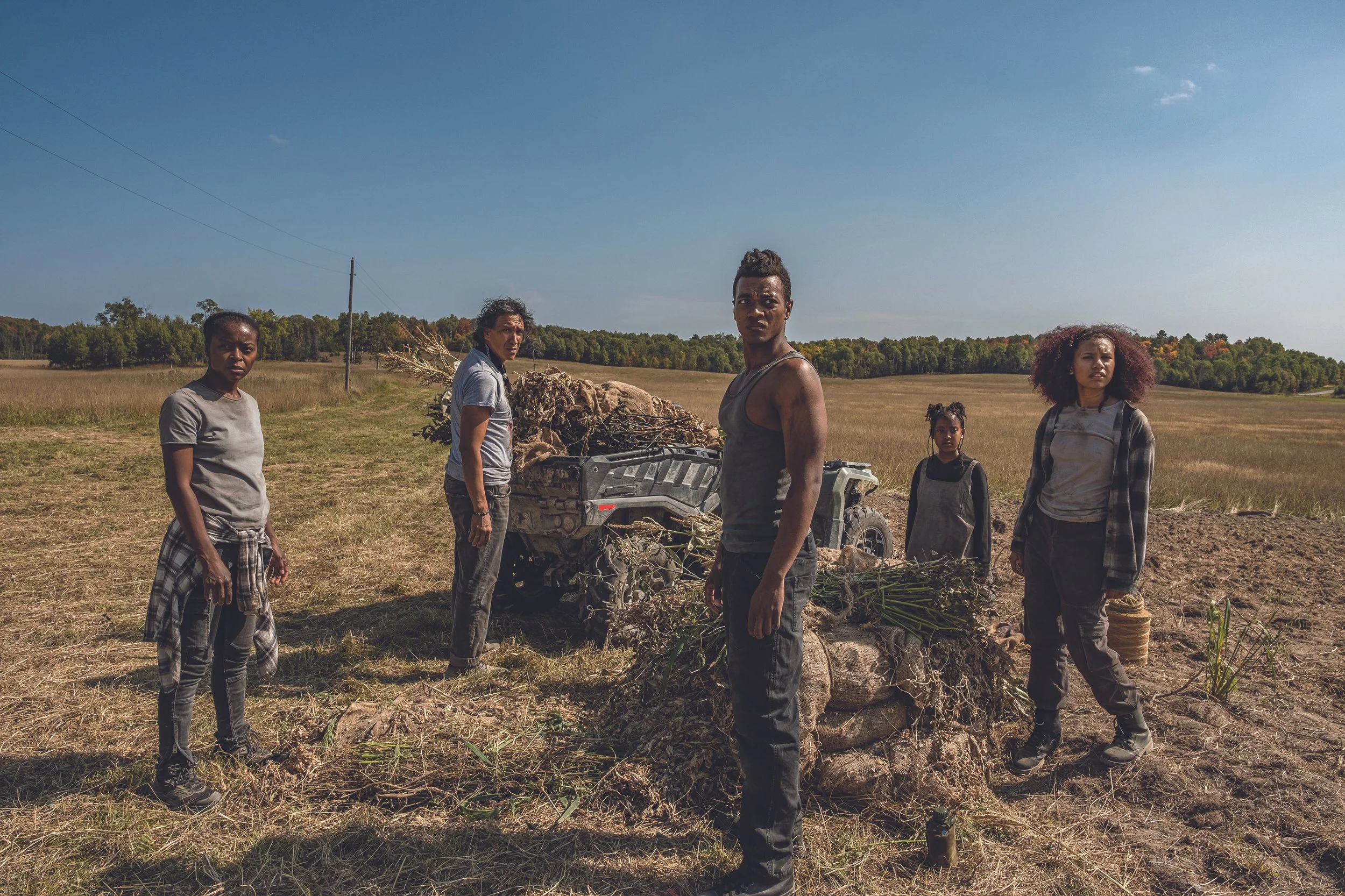
The Freeman family led by Hailey (Danielle Deadwyler) and Galen (Michael Greyeyes) pull together as a disciplined and tightly knit unit.
Cineaste: Would I be correct in saying that 40 Acres is an exercise in creating tension?
Thorne: There’s an inherent tension in the film and it’s obviously intentional. I love the idea of creating a film that is suspenseful and needs tension to play out, but the film’s main conflict is between mother and son. They have different ideologies and perspectives on how survival should work. It’s a universal generational divide. On one hand, the older generation has a sense of what they think works. They’ve seen enough of the world to understand it, and they try to pass that along to the younger generation that doesn’t want to hear that shit. The younger generation thinks their elders don’t know everything and, quite frankly, their world is a little different from what their parents’ world was or is. That tension drives this film.
I also wanted to create a film that was more character-driven, that harks back to some of the films that I appreciate from the Seventies and even the Nineties. I love the Nineties for its character-driven thrillers, where you’re willing to go along with someone who might not be making the right choices, and you’ll watch them fumble and stumble.
There’s a tension in telling somebody you know that they shouldn’t do what they’re about to do and engaging the audience in that is very exciting. Audiences will say that in this film they’re angry at Manny. People have told me that they were yelling at the screen when Manny was doing certain things. I’m happy you’re yelling at him because you care about him. But you also forget that at some point in time you were a teenager like Manny, and you made stupid decisions as well. There’s also something exciting about having these opposing forces at work in the film—not just the characters but also playing with silence and then having an explosion of violence. It’s about playing with movement, light, and sound design, which are all great for creating tension.
Cineaste: Do you perceive 40 Acres as being political and, more broadly speaking, would you agree that all art is political?
Thorne: A lot of times, for people of color—and Black filmmakers, especially—whether we want to or not, the nature of having an expression that references our experience in this world, especially in places that have a colonial history, is inherently something that’s going to be seen as political, whether it’s our intention or not. Sometimes it’s intentional—we want to speak or make a point about something. But sometimes we don’t want to be burdened with that idea—you just want to tell this story and not have it be explicitly about something in that way. But it is tied to our identities. A big part of what 40 Acres is about for me is that it’s a kind of rebellion in response to how characters in these films have been portrayed before and wanting to see a different version. I wanted to see a family I’d never seen before fighting back to secure the power and wealth that Black and indigenous people have been denied, including being removed from, and even killed for, their land. So, yeah, I wanted to see this family empowered in this fight and to see them aligned and fighting together. That is a form of rebellion against what has been presented in the past. This is especially true with Westerns in which Black and indigenous characters are relegated to the background, or they’re either villains or victims. So, in a way, there was a kind of rebellion to 40 Acres.
Did I intentionally want to be political? Did I want to throw that in everybody’s face? No, because there’s also a side of this film that wants to just be a fun thrill ride. I wanted to make an exhilarating film, one that is fun and enthusiastic for everybody. One could say there’s a lot of political commentary in 40 Acres. But I hope that you can also have a great time as well.
Cineaste: It’s necessary to also consider how the audience will politicize a film.
Thorne: That’s true and sometimes those are the things that make a film something of the moment, right? It’s such a mystery. Film is a beautiful art form, as is music. Songs become anthems for certain eras, and sometimes that’s because an artist reacts to something and it captures the cultural mood. Films can say so much, especially genre, including science fiction and dystopian films. They can speak about conflicts and sociopolitical issues in a way that get you to see things in a different way. A film about aliens from space, for example, can be seen as being about immigration. Films can have you look at something that’s going on in your society but remove the intense emotions that are sometimes associated with it.
Hailey (Danielle Deadwyler) and Galen (Michael Greyeyes) reflect on their current situation and the future.
Cineaste: We understand Hailey’s paranoia and cynicism but, as an audience, despite Manny’s naive and silly choices, we share his desire to believe in a different world than the one his mother believes in. One might describe Hailey as the rational mind and Manny as the emotional and impulsive heart. And by juxtaposing the characters in this way, you force your audience to put themselves in either Manny or Hailey’s position or maybe create a conflict about who we identify with.
Thorne: That’s a wonderful way of looking at it, which was definitely how I was. We present this world in which the stakes are literally life and death and there are no greater stakes than starving to death. It brings this world into a primal place.
Hailey’s past is filled with the trauma she has seen and experienced as a soldier. She has seen the world crumble in front of her. A rational person is going to say, “We need to isolate; we cannot trust anybody. I’ve seen what trust does.” And she’ll essentially construct a prison around her family—she’s a warden keeping everything out. The psychology is that it’s a dark place to live in, and Danielle shows so many colors in that, including a logical side, so it makes complete sense what she wants to do.
Manny is someone who has grown up in a large part of that, but he has also seen a different world. He saw his grandfather welcome people onto his farm when things were going bad. There was an aspect of faith and understanding that hope is needed for people to get through things. He experienced that at a young age, and it left an impression on him. That’s still within him, and he’s yearning, at his age now, for something different, something possible. He’s seen these different ways, whereas Hailey has been ground down into her beliefs, and her everyday existence is just listening to the echoes of people who are suffering and being betrayed. That’s all she does. She just sits and listens to people and makes notes about the surrounding developments, while Manny is out exploring and looking for a new life. So, yes, there is that tension that exists between them.
It was a generational thing for me. When you’re younger, you see the world for its infinite possibilities—where it can go and how you can participate. You have all these hopes and dreams and, as you get older, the world weighs on you, and it starts to reveal itself as a cold place sometimes. Over time, as you get beat down by it, you can become resolutely convinced about how the world works. A lot of times, parents come with this world of experience, having been through a lot of traumas. I know it was the case for my mother, who would say, “This is how the world is” because of what she’d experienced.
Ultimately, Manny is saying, as are many of the younger generation, “I don’t live in your world; you live in your world. But my world can be different.” They want to believe in the power of that. That conflict is extremely important throughout the film, and it’s ultimately not like one side is right or wrong. You can’t live in a world of pure hope and ignore all the surrounding dangers. But you also can’t live by removing yourself from the possibility of hope because that’s not living. There’s definitely a conversation between those two sides throughout the film.
Galen (Michael Greyeyes) investigates the further reaches of the farm for a possible breach.
Cineaste: Inasmuch as 40 Acres can be interpreted as a political film, is it also a film about the primitive nature of human beings? Is it commenting on how, if civilized order hangs by a thread, how close we are to spiraling into these primitive instincts?
Thorne: Nothing shook me to the core and made it more real for me than the pandemic we went through. During those first eight months, none of us knew how that was going to turn out, and you began to see how fragile the infrastructure of our Western world is. We’re relying on a food chain that’s a complex system to make sure that all the towns and cities we decide to live in have a food supply on a consistent basis. The supply of food is the only thing that’s holding society together. Once you take that away, then people are going to revert to a survival mentality. And when you’re in that place, morals go out the window—people will literally do anything to save themselves. So, it’s a very dark place to exist in where we are hanging by a thread, and that’s the place I wanted to take this family and have the story develop.
Cineaste: One of the other ways to create challenging stories is not to focus on creating characters that are likable and sympathetic but characters whose complicated and layered natures spark our interest.
Thorne: People are layered. Everybody likes to think of themselves as good people, but some days you’re less so. Some days you make little decisions that hurt others and are not in your best interest or even the interests of your loved ones. A lot of us fall off the wagon along this journey and I think that’s what makes somebody sympathetic. If you can feel yourself in a character, or you’re yelling at them to not do something, then part of that reaction is because you know you would do the same thing, and you’re mad at yourself—they’re representing a part of you. Seeing someone spiral in a film is engaging because you want this person to get out from under whatever it is. You’ll follow them because we see ourselves in these characters and situations. Flawed and messy characters are infinitely more interesting to me than somebody who’s likable.
Cineaste: The regimented daily lives the characters lead, which Manny pushes back against, work twofold. These processes are necessary to survive, but in a dystopian world, they’re essential for creating meaning and purpose, as well as the rhythm and routine that human beings depend upon.
Thorne: It’s about purpose and Hailey, coming from a military background, understands that. So much about being in the military are the drills and the routine of building structure into your life. And part of that is giving your mind and body something to challenge you, so that you’re not thinking about the horrors that may come from what you have to do.
I don’t know if distraction is the word, but it gives you purpose. And the purpose is in front of you for today—this is what you have to do. And your duty helps to sustain the bigger picture. So, in a world that does not have much entertainment, or some of the frivolous things that we get to engage in, the maintenance of a farm is vitally important.
Hailey knows that, but I also wanted to show some of the monotony of that for them and how it was particularly affecting Manny, who is seeking an escape, whether it be through his music or just exploring off the farm. But Hailey understands you need structure to maintain a fortress, and she has got the family dialed in.
Manny (Kataem O’Connor) and Dawn (Milcania Diaz-Rojas) sweep the homestead for possible armed intruders.
Cineaste: Would you agree with the idea that viewers are the ones that complete a film?
Thorne: The beauty of cinema is that through the process of making it, as a filmmaker, you’re refining the story you’re telling. You’ll come to understand more specifically what you’re saying through the different stages of production. At the script stage, you have this blueprint; you have this stuff down on the page of what these characters are going to say. Then the actors come in, you have the environment, and the production begins to shape how what you’re saying comes out.
Then you go into postproduction, and you start to refine it and listen. It starts to tell you what it wants to say even though you’re trying to sculpt it. A film is this crazy, evolving dream that multiple people help you build. Your editors and sound designers shape it intensely, along with the way you incorporate music—all these things help you to sculpt it. Then it’s influenced by your life, and what’s going on socially and politically in the world. It’s this conversation initially between a small group of people and then, at some point, that conversation expands when you give it to the audience. You’re no longer influencing it, but they are, and they’re bringing their life experiences and how they view the world to it.
To some, the film will resonate deeply, and to others it will mean absolutely nothing. But the ultimate beauty of film is you are trying to refine what you’re saying, you’re trying to engage in this conversation. And the film does that on its own as it lives. At the time, it could be a reaction to something that’s going on in the world or that was going on in your life. But ten or fifteen years later, a viewer can revisit the film, and it can speak to them in a deep way.
A film is constantly in conversation with the world and there’s a beauty to that, and there’s a wonderful responsibility involved in that as well. I’m very proud of being a filmmaker and being able to touch people and share my point of view well beyond the time that we created this thing. To have conversations with the future is an honor.
40 Acres is distributed in the United States by Magnolia Pictures.
Paul Risker, a U.K.-based film critic and PopMatters contributing editor, has written for numerous periodicals.
Copyright © 2025 by Cineaste, Inc.
Cineaste, Vol. LI, No. 1
Quisque iaculis facilisis lacinia. Mauris euismod pellentesque tellus sit amet mollis.